Why California Business Licenses Matter for Your Contracting Business

Last updated: August 31st, 2026
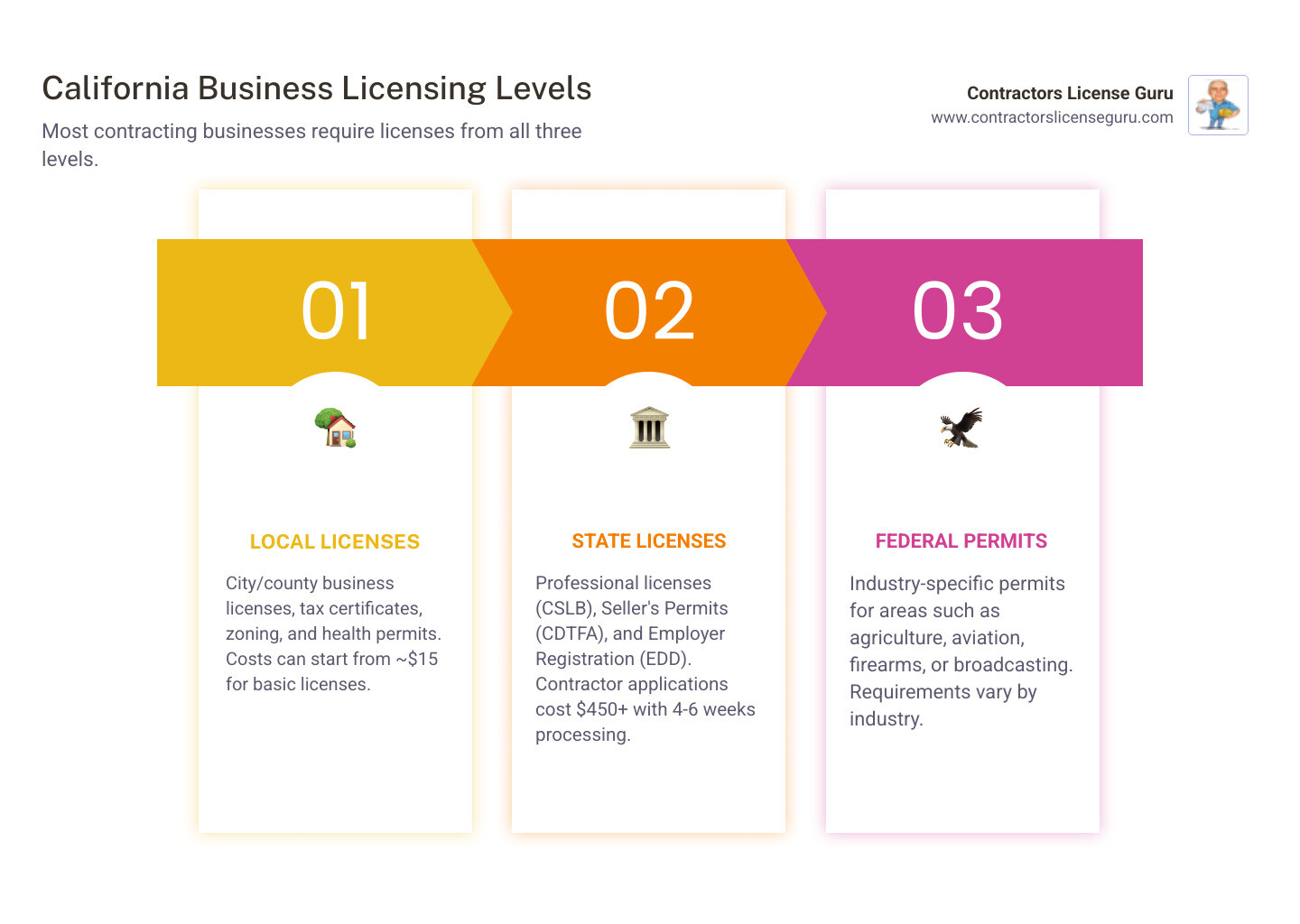
California business licenses are not issued by the state as a single permit—instead, they consist of a complex web of local, state, and federal requirements that vary based on your business type, location, and industry. Here’s what you need to know:
Key Facts About California Business Licenses:
- No statewide general business license exists – regulation happens at the city/county level
- Most businesses need a local business license or tax certificate from their city or county
- Contractors must obtain a state license from the California Contractors State License Board (CSLB)
- Seller’s permits are generally required if you sell or lease tangible personal property that is subject to sales tax.
- Operating without proper licenses can result in fines, legal action, or even jail time for contractors
- Costs range widely – from $15 for basic local licenses to $450+ for contractor applications
- Processing times vary – from immediate online permits to 4-6 weeks for professional licenses
If you’ve ever felt overwhelmed trying to figure out which licenses and permits your California contracting business actually needs, you’re not alone. California is the most populous state in America, and its licensing requirements are among the most complex in the nation. Between city requirements, county regulations, state permits, and industry-specific licenses, navigating the system can feel like a full-time job.
I’m Phil Cocciante, also known as The License Guru, and I’ve spent over 20 years helping contractors steer California business licenses and CSLB requirements. After five years as a license application technician at the Contractors State License Board itself, I founded Contractors License Guru to help thousands of contractors cut through the confusion and obtain their licenses correctly the first time.
What is a California Business License and Why is it Required?
When we talk about a “California business license,” it’s important to understand that there isn’t a single, all-encompassing state-issued license that covers every business. Instead, California’s approach is more decentralized, relying on a combination of local, state, and sometimes federal requirements. This means what one business needs might be completely different from another, even if they’re in the same general industry. This complexity is why California is often described as one of the “biggest headaches for business owners who need to obtain a business license.”
So, why are these licenses and permits required? Simply put, they ensure that businesses operate legally, safely, and fairly within the state. Each license serves a specific purpose:
- Local Requirement: Your city or county wants to know what businesses are operating within its jurisdiction. This helps them regulate local commerce, ensure public safety, and collect local business taxes. A local business license or tax certificate is almost always the first step, even if you’re a home-based business.
- Industry-Specific Permits: Many industries, especially those impacting public health, safety, or the environment, require specialized permits. Think of food establishments (California issues more food establishment permits than there are people in most U.S. territories!), contractors, or professionals like doctors and lawyers. These permits ensure that businesses meet specific standards and qualifications.
- Legal Operation & Tax Purposes: Licenses are fundamental to legal operation. They confirm your business is registered and accountable. For tax purposes, they allow the state and local governments to properly identify businesses for collecting sales tax, income tax withholding, and other fees. For example, certain businesses that are not required to hold a seller’s permit may be required to register with the CDTFA as a qualified purchaser and report use tax. From January 1, 2024, through December 31, 2028, this generally applies when a business makes more than $10,000 in purchases subject to use tax during a calendar year and the use tax was not otherwise paid.
- Consumer Protection: Professional licenses, like those issued by the Contractors State License Board (CSLB), protect consumers by ensuring that individuals performing specialized work are qualified and adhere to industry standards.
The Consequences of Non-Compliance
Operating a business without the required California business licenses is not just a minor oversight; it can lead to serious repercussions. We’re talking about fines, legal action, and even the shutdown of your business.
- Fines and Penalties: Local governments can impose daily fines for operating without a general business license. These can quickly add up, creating a significant financial burden.
- Legal Action: You could face civil lawsuits or even criminal charges, especially if your unlicensed operation leads to harm or fraud.
- Business Shutdown: Authorities have the power to order an unlicensed business to cease operations, effectively shutting you down until you comply.
- Contractor License Penalties: For contractors, the stakes are even higher. Operating without a license from the CSLB can result in six months in jail and/or a $5,000 fine, plus administrative fines. The penalties escalate for continued non-compliance. Furthermore, if you perform work without a license, you may be required to return all compensation paid, and the owner can have a complete defense against your claims. This is why understanding California business licenses is absolutely critical for our contracting clients.
Types of Business Licenses and Permits in California
Navigating the licensing landscape in California means understanding the different levels and types of permits you might need. It’s like building a house: you need a foundation (local permits), a sturdy frame (state licenses), and sometimes specialized features (federal permits).
Understanding Local California Business Licenses and Tax Certificates
Most businesses, regardless of their structure or industry, will need to obtain a local business license or business tax certificate from the city or county where they operate.
- General Business License / Business Tax Certificate: This is your basic permission to operate in a specific locality. The name varies; for example, San Diego issues “business tax certificates” instead of business licenses. Fees vary widely by locality, ranging from as low as $15 to a few hundred dollars. In San Diego, fees start at $38. In San Francisco, the business registration fee ranges from $25 to $500 per year, depending on your business’s gross receipts. The cost of a general business license varies by the city or county where your business is based. If your business has offices in multiple cities, you may need a separate license for each location.
- City vs. County: If your business is within incorporated city limits, you’ll apply to that city. If you’re in an unincorporated area, you’ll typically apply to the county government.
- Home Occupation Permit (HOP): If you’re running your business from home, many cities require a Home Occupation Permit in addition to a general business license. For instance, in Santa Ana, the home occupation permit costs about $50. In Oakland, the home occupation permit fee is $95—the same as the fee for a general business license.
- Zoning Permits: If you need to modify your home or business location to comply with local zoning laws (e.g., adding a separate entrance for customers or changing the use of a property), you might need a zoning variance or conditional use permit. These can cost anywhere from a few hundred to thousands of dollars, depending on the scope of the project, as seen in Los Angeles County.
- Building Permits: Similarly, any structural changes, renovations, or new construction will likely require a building permit. These fees also vary significantly, potentially reaching hundreds to thousands of dollars in Los Angeles County.
- Health Permits: Businesses dealing with food, such as restaurants, cafes, or even home-based cottage food operations, will need health permits. For home-based food businesses, Class A Cottage Food registration (for direct sales only) typically costs $100 to $150, while Class B (direct and indirect sales) permits range from $250 to $500. In Los Angeles County, Class A registration costs $118 and Class B registration costs $292.
State-Level Licenses and Registrations
Beyond local requirements, several state-level licenses and registrations are crucial for many California businesses.
- Professional Licenses: If your business involves a specific profession, you’ll likely need a state-issued professional license. The California Department of Consumer Affairs (DCA) licenses and regulates several million professionals in more than 280 license types, including doctors, lawyers, accountants, real estate agents, and cosmetologists. You can find out more about professional licensing through the Department of Consumer Affairs.
- Contractors State License Board (CSLB): For anyone performing construction work in California, a license from the CSLB is non-negotiable. The CSLB has various classifications, including General Engineering (A), General Building (B), Residential Remodeling (B-2), and numerous Specialty Contractor (C) licenses (e.g., C-10 Electrical, C-36 Plumbing). A license from the California Contractors State License Board costs $450 for the application fee, plus another $200 for the initial license fee for a sole owner. We specialize in helping contractors steer these specific requirements. You can also check a contractor’s license through their online lookup tool.
- Seller’s Permit: If you sell or lease tangible personal property that is subject to sales tax, you must obtain a seller’s permit from the California Department of Tax and Fee Administration (CDTFA). This applies whether you’re a wholesaler or a retailer. There’s no fee for obtaining a seller’s permit, but you might be asked for a security deposit. You can register online through the CDTFA website.
- Employer Registration: If you plan to hire employees, you’ll need to register with the California Employment Development Department (EDD) to handle payroll taxes, unemployment insurance, and disability insurance. Businesses that pay more than $100 in wages in a calendar quarter must register with the EDD. The California Employment Development Department can help you get registered.
- Fictitious Business Name (FBN/DBA): If you operate your business under a name different from your legal name (e.g., “The Best Bakery” instead of “Jane Doe Sole Proprietor”), you’ll need to file a Fictitious Business Name (FBN), also known as a “Doing Business As” (DBA) with your county clerk. This isn’t a license but a registration. In Los Angeles County, the first-time fee for filing an FBN is $26 for the business name and business owner, with additional costs for extra names. In San Diego County, the FBN filing fee is $54, with additional costs for extra business names or owners. After filing a DBA, California law requires you to publish the name in a local newspaper for four consecutive weeks, which can cost anywhere from $30 to $500 each week.
Federal Licenses and Permits
While most of your licensing will be at the local and state levels, certain industries also require federal licenses or permits. This is less common for many small businesses but crucial if you operate in specific regulated sectors.
- Federally licensed industries include:
- Agriculture
- Aviation
- Firearms
- Alcohol
- Broadcasting
- Fishing and wildlife
- Nuclear energy
- Mining and drilling
- Transportation
- You can access a list of all federally licensed activities, along with links to more information, through the U.S. Small Business Administration.
How to Get Your California Business Licenses: A Step-by-Step Guide
Getting your California business licenses might seem daunting, but breaking it down into manageable steps makes the process much clearer. We’ve helped countless businesses, especially contractors, steer this path successfully.
Step 1: Determine Your Business Structure and Register It
Before you can even think about licenses, you need to decide on your business’s legal structure. This decision impacts everything from your liability to how you file taxes. Common structures include:
- Sole Proprietorship: Simple to set up, but offers no personal liability protection.
- Partnership: Similar to a sole proprietorship but with two or more owners.
- Limited Liability Company (LLC): Offers personal liability protection and flexible taxation. Registering an LLC in California costs $70, plus an $800 annual LLC tax due in the fourth month after formation. There’s also a $20 fee to file a Statement of Information within the first 90 days.
- Corporation (S-Corp, C-Corp): Provides the strongest liability protection but has more complex setup and compliance requirements.
Once you’ve chosen your structure, you’ll need to register it. Most formal structures like LLCs and Corporations must be registered with the California Secretary of State’s office. You can find resources to form a business with the Secretary of State.
Step 2: Obtain Your Federal and State Tax IDs
Next up are your tax identification numbers. These are essential for filing taxes and, in many cases, for obtaining other licenses.
- Employer Identification Number (EIN): If your business is an LLC, corporation, partnership, or if you plan to hire employees, you’ll need an EIN from the IRS. This is like a Social Security number for your business. You can apply for an EIN online on the IRS website.
- California Payroll Tax Account Number: If you have employees, you’ll also need to register with the California Employment Development Department (EDD) to get a state payroll tax account number. This is for state income tax withholding, unemployment insurance, and state disability insurance.
- Qualified Purchaser Use Tax Registration: If your business is not required to hold a California seller’s permit, you may still be required to register with the CDTFA as a qualified purchaser to report and pay use tax. From January 1, 2024, through December 31, 2028, this generally applies if you make more than $10,000 in purchases subject to use tax during a calendar year and that tax was not otherwise paid to a retailer authorized or required to collect it. You can consult the FAQs for the Qualified Purchaser Program for more details.
- Seller’s Permit for Veteran Vendors: If you are an itinerant veteran vendor, you should visit the Tax Guide for Veteran’s Tax Topic page to find out whether you are required to have a seller’s permit.
Step 3: Identify All Required Permits with CalGOLD
This is where many businesses get stuck, but California has a fantastic resource to help: CalGOLD.
- Using the CalGOLD permit assistance tool: The Governor’s Office of Business and Economic Development (GO-Biz) created CalGOLD to help you find the specific permit, license, and registration requirements for your business. It’s a comprehensive database that links you to various state, local, and federal agencies.
- Searching by Business Type & Location: You can search CalGOLD by entering your business type (e.g., “construction contractor,” “restaurant,” “retail store”) and your city or county. The tool will then provide a customized list of potential requirements and links to the relevant agencies. It’s an invaluable first stop in identifying your necessary California business licenses.
Step 4: Apply for Local, State, and Industry-Specific Licenses
Once you’ve identified all the necessary California business licenses and permits, it’s time to apply.
- Application Process: Each agency will have its own application forms and procedures. Generally, you’ll need to provide your EIN or SSN, a description of your business activity, your legal name (or DBA), your start date, business address, and owner contact information. Some applications may require proof of other state licenses (like your CSLB license for contractors).
- Submitting Applications: Many applications can now be submitted online, while others may require mail or in-person submission. Make sure to follow each agency’s instructions carefully.
- Paying Fees: Be prepared to pay application fees. These vary widely, as we’ll discuss in the next section.
- Online Businesses: Even if your business operates primarily online, you are regulated by the state, county, and city where your physical business address is located. This means you’ll still need to follow California and local regulations to obtain the proper licenses and permits for your operating location.
Costs and Timelines for California Business Licenses
Understanding the financial and time investment required for California business licenses is crucial for proper planning. The costs and processing times can vary dramatically depending on your business type, location, and the specific permits needed.
Costs of Obtaining California Business Licenses
The fees associated with obtaining California business licenses are not uniform. They depend heavily on the issuing authority (city, county, state), the type of business, and sometimes even the projected revenue.
- LLC Formation Costs:
- Filing Articles of Organization for an LLC: $70
- Filing a Statement of Information (within 90 days of formation): $20
- Annual LLC Tax: $800 (due in the fourth month after formation)
- Total initial costs for forming an LLC can be around $820, including initial taxes and filing fees within the first four months.
- Local License Fees: These are highly variable.
- San Diego Business Tax Certificates: Start at $38.
- San Francisco Business Registration Fee: Ranges from $25 to $500 per year, depending on your business’s gross receipts.
- Local business license fees generally range from as low as $15 to a few hundred dollars.
- Home Occupation Permit Fees:
- Santa Ana: About $50.
- Oakland: $95 (same as their general business license fee).
- Contractor License Fees:
- Application fee for CSLB: $450
- Initial license fee for a sole owner: $200
- DBA Filing and Publication Costs:
- Los Angeles County FBN filing fee: $26 (first-time, for business name and owner)
- San Diego County FBN filing fee: $54
- Newspaper Publication: Can cost anywhere from $30 to $500 each week for four consecutive weeks, depending on the newspaper and location.
- Industry-Specific Permit Fees:
- Class A Cottage Food registration (LA County): $118
- Class B Cottage Food registration (LA County): $292
- Zoning and Building Permit Costs: These can be significant, especially for commercial properties or major renovations. In Los Angeles County, zoning and conditional use permits can cost anywhere from a few hundred to thousands of dollars. Building permits can also range from a hundred to thousands of dollars.
Here’s a snapshot of some common local fees:
| City/County |
Type of License/Permit |
Estimated Cost |
| San Diego |
Business Tax Certificate |
Starts at $38 |
| San Francisco |
Business Registration Fee |
$25 – $500 per year (based on gross receipts) |
| Santa Ana |
Home Occupation Permit |
About $50 |
| Oakland |
Home Occupation Permit |
$95 |
| Los Angeles Co. |
Class A Cottage Food Registration |
$118 |
| Los Angeles Co. |
Class B Cottage Food Registration |
$292 |
| Los Angeles Co. |
FBN Filing Fee (first-time) |
$26 |
| San Diego Co. |
FBN Filing Fee |
$54 |
| Statewide |
CSLB Application Fee |
$450 |
| Statewide |
CSLB Initial License Fee |
$200 (for sole owner) |
How Long Does It Take to Get a License?
The time it takes to secure your California business licenses also varies widely. Some can be almost instant, while others require a lengthy review period.
- City/County License Timelines: Most businesses can expect to get their general business licenses within a few weeks. In San Diego, for example, it takes up to two weeks to receive a business tax certificate.
- Home Occupation Permits: The approval time for a home occupation permit depends on local regulations and whether any inspections are required, typically a few weeks.
- Professional License Timelines: State professional licenses often take longer. The California Contractors State License Board (CSLB) takes four to six weeks just to acknowledge it has received an application and can take even longer to approve one, sometimes months, depending on the complexity and completeness of the application.
- Seller’s Permit Issuance: If you apply online through the CDTFA, your seller’s permit can often be issued immediately.
- DBA Filing Period: Filing an FBN/DBA with the county typically takes a few weeks, plus the additional four weeks required for newspaper publication.
- Zoning and Building Permits: These can take a month or longer, especially if they involve inspections or public hearings.
Frequently Asked Questions about California Business Licenses
It’s natural to have questions about such a complex topic. Here, we address some of the most common inquiries we receive about California business licenses.
Does an LLC need a business license in California?
This is a common point of confusion! An LLC (Limited Liability Company) is a legal business structure, not a license to operate. California doesn’t necessarily require all businesses (of any structure) to obtain a single, statewide operating license.
However, almost every LLC operating in California will need various California business licenses and permits:
- Local Business License: Most businesses, including LLCs, are required to obtain a general business operating license or business tax certificate from their city and/or county government.
- State-Specific Permits: Depending on the industry, an LLC may need specific state permits or licenses. For example, an LLC that performs contracting work must still obtain a CSLB contractor license. An LLC that sells or leases tangible personal property that is subject to sales tax will generally need a seller’s permit from the CDTFA.
- Employer Registration: If the LLC has employees, it must register with the EDD.
So, while an LLC itself isn’t a license, forming an LLC is a foundational step, and then you’ll proceed to obtain the necessary operational licenses and permits based on your activities and location.
Do I need a business license in California to sell online?
Yes, most likely. Even if your business is entirely online, it still has a physical operating location. This is typically the address you list as your business address for tax purposes, whether it’s your home or another commercial space.
- Physical Business Location: Your online business is regulated by the state, county, and city where that physical address is located. If you’re based in California, you must follow California and local regulations to obtain the proper licenses and permits.
- Home-Based Business Rules: If you operate your online business from home, you will likely need a Home Occupation Permit from your city or county, in addition to a general local business license.
- Seller’s Permit Requirement: If you sell tangible personal property online that is subject to California sales tax, you may be required to obtain a seller’s permit from the CDTFA. The specific requirement can depend on how and where the sales are made, including whether sales are made through a marketplace facilitator.
What are the penalties for operating without a license in California?
The consequences of operating without the required California business licenses vary depending on the specific license you’re missing and the jurisdiction involved, but they are rarely pleasant.
- Fines and Legal Action: For missing a general local business license, you can face significant fines. Cities and counties regularly enforce these requirements, and penalties can accrue daily. Continued non-compliance can lead to civil actions or injunctions against your business.
- Contractor License Penalties: For contractors, the penalties are particularly severe. Operating without a CSLB license can lead to:
- Up to six months in county jail.
- A fine of up to $5,000.
- Additional administrative fines.
- The requirement to return all compensation received for unlicensed work.
- Loss of legal standing to pursue payment for your services.
These penalties are designed to deter unlicensed activity and protect the public. It’s always best to ensure you have all your ducks in a row before starting operations.
Your Guide to Navigating California’s Licensing Maze
We know that navigating the complex landscape of California business licenses can feel like an endless maze. From understanding the difference between city and county requirements to deciphering state-specific professional licenses and federal permits, it’s a lot to take in.
However, by breaking down the process into manageable steps—determining your business structure, obtaining tax IDs, utilizing resources like CalGOLD, and carefully applying for each required license—you can ensure your business is fully compliant and set up for success.
Compliance isn’t just about avoiding penalties; it’s about building a legitimate, trustworthy business that operates within the legal framework designed to protect both you and your customers. We understand the intricacies of these requirements, especially for contractors, and we’re here to help.
For our contracting clients, understanding the Contractors State License Board (CSLB) is paramount. We’ve compiled an extensive resource to guide you through this specific state license. Check out our comprehensive guide: A Complete Guide to the Contractors State License Board in California.