Why Contractor License Services Matter for California Contractors
Contractor License Services help aspiring and established contractors steer the complex process of obtaining and maintaining a California contractor license. Whether you’re applying for your first license, adding a new classification, or renewing an existing one, these services provide expert guidance through application preparation, exam readiness, and regulatory compliance.
Quick Answer: What Are Contractor License Services?
Contractor License Services assist with:
- Application Processing – Completing and submitting accurate CSLB applications
- Exam Preparation – Study materials, practice tests, and courses for Law & Business and Trade exams
- Experience Documentation – Verifying and presenting your qualifying experience
- License Maintenance – Renewals, bond verification, and continuing education
- Specialized Support – Exam waivers, overseas experience evaluation, and classification changes
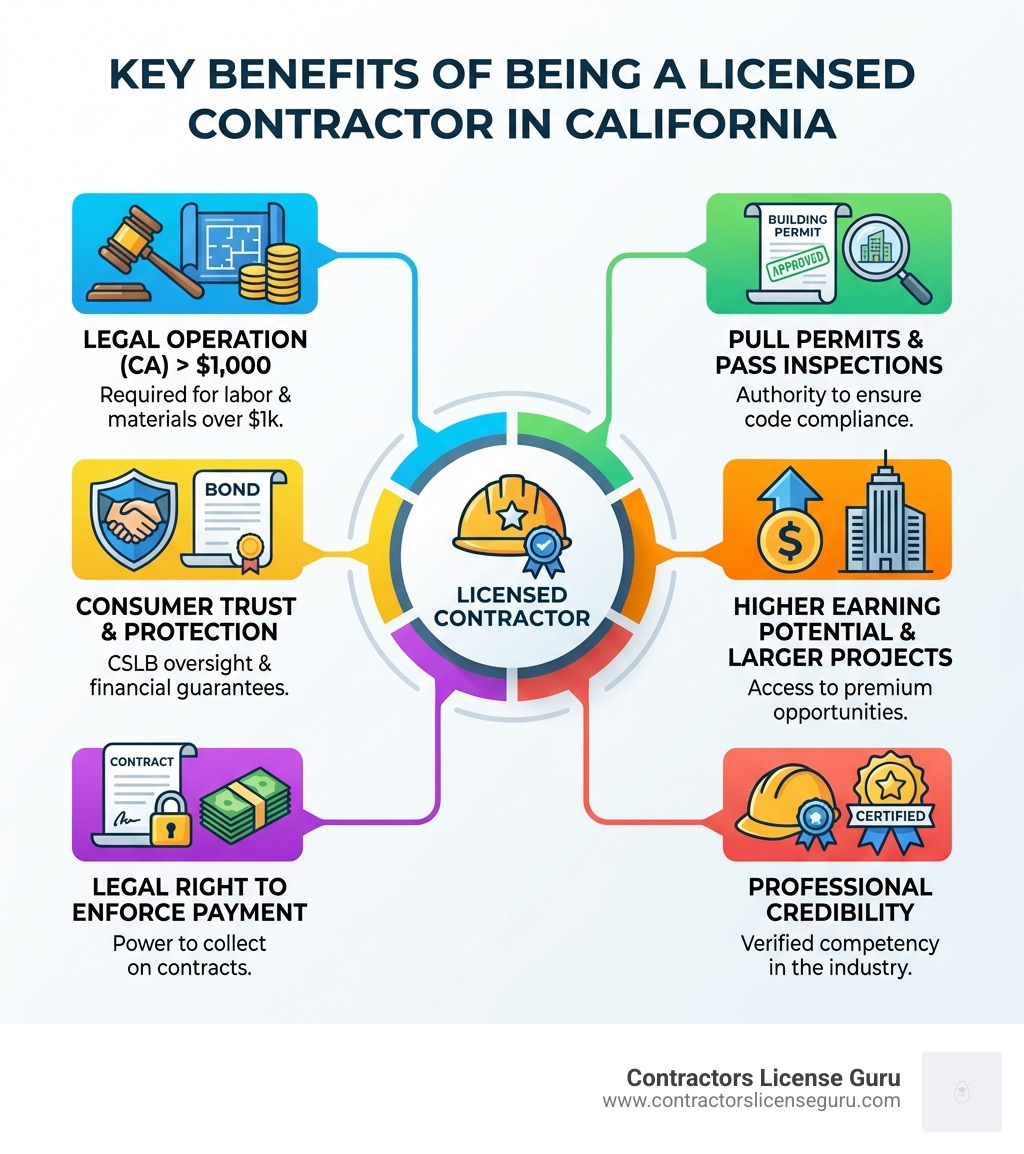
In California, anyone contracting to perform work valued at $1,000 or more for labor and materials must hold a current, valid license from the Contractors State License Board (CSLB). This isn’t just a legal formality. A contractor license protects consumers through financial guarantees, ensures professional competency through examination requirements, and gives contractors the legal right to pull permits, bid on projects, and enforce payment contracts.
The licensing journey involves multiple steps: determining your classification, documenting four years of journeyman-level experience, passing two examinations, obtaining a contractor’s bond, and completing fingerprinting. Each step has specific requirements and potential pitfalls that can delay or derail your application.
I’m Phil Cocciante, owner of Contractors License Guru, and I’ve spent over 20 years helping contractors successfully steer the CSLB licensing process. After five years as a license application technician at the CSLB itself, I understand exactly what the Board requires and how to get applications approved efficiently.
Understanding California’s Contractor License Requirements
Operating as a contractor in California without a proper license is like trying to build a house without a foundation – it’s unstable, illegal, and ultimately, it won’t stand. The Contractors State License Board (CSLB) is the regulatory body that oversees licensing for the construction industry in California. Their role is to protect the public by ensuring that contractors are qualified, competent, and adhere to state laws. This means setting standards for experience, requiring examinations, and ensuring financial responsibility.
For us, understanding the CSLB’s regulations is paramount. We help steer these intricate rules, ensuring our clients meet every requirement for their specific license classification.
Types of Contractor Licenses
The CSLB categorizes contractor licenses into three main classes, each with various sub-classifications designed to specify the type of work a contractor is legally permitted to perform:
- Class A: General Engineering Contractor This license is for contractors whose principal business is in connection with fixed works requiring specialized engineering knowledge and skill. Think of large-scale infrastructure projects like highways, bridges, dams, airports, or major utility systems.
- Class B: General Building Contractor The Class B license is for contractors whose principal business is in connection with structures built, being built, or to be built, requiring in their construction the use of at least two unrelated building trades or crafts. This is your go-to license for constructing or remodeling homes and commercial buildings. A Class B contractor can take a contract to build an entire structure but cannot perform specialized work (like plumbing or electrical) unless they hold the appropriate specialty license or subcontract that work to a properly licensed specialty contractor.
- Class C: Specialty Contractor These licenses are for contractors who perform work requiring special skill and whose principal contracting business involves the use of specialized building trades or crafts. California has over 40 different “C” classifications, each specific to a particular trade. Some common examples include:
- Electrical (C-10): For installing, repairing, or maintaining electrical systems.
- Plumbing (C-36): For installing, repairing, or maintaining plumbing systems.
- HVAC (C-20): For heating, ventilation, and air conditioning systems.
- Landscaping (C-27): For landscape construction, including irrigation, planting, and hardscaping.
- And many more, from roofing (C-39) to concrete (C-8) and painting (C-33).
Beyond these core classifications, the CSLB also recognizes specific business structures:
- LLC Licenses: If you operate your contracting business as a Limited Liability Company (LLC), you’ll need an LLC license, which has specific requirements beyond those for sole proprietorships or partnerships, including additional bond requirements. We can help you steer these specific needs.
- Joint Venture Licenses: When two or more licensed contractors (or entities) come together to bid on or perform a single project, they may need a Joint Venture License. This ensures that the combined entity is also properly licensed for the scope of work.
Eligibility Requirements
Before you even think about which license classification is right for you, you need to meet the basic eligibility criteria set by the CSLB:
- Age: All applicants must be at least 18 years of age or over. No exceptions here, folks!
- Experience: This is often the biggest hurdle. You must have at least four years of journeyman-level experience in the classification for which you are applying. This experience must be within the last 10 years and can include:
- Working as a journeyman, foreman, supervising employee, or contractor.
- Experience gained while working for an employer, or self-employment.
- The CSLB defines “journeyman-level” as a person who has completed an apprenticeship program or is an experienced worker, not a trainee, and is able to perform the trade without supervision.
- Qualifying Individual (QI): Every licensed entity (individual, partnership, corporation, or LLC) must have a Qualifying Individual. This person is responsible for the direct supervision and control of the licensee’s construction operations. The QI must possess the necessary experience and pass the required examinations. Often, the applicant themselves will be the QI, but it can also be an employee.
Financial and Legal Prerequisites
Getting a license isn’t just about proving your skills; it’s also about demonstrating financial responsibility and a clean record.
- License Security (Surety Bonds): In California, all licensed contractors are required to carry a contractor’s bond. This bond, currently set at $15,000, protects consumers from financial harm if a contractor fails to complete a project or violates CSLB laws. LLC licenses have additional bond requirements, including a $100,000 LLC Employee/Worker Bond and a $12,500 Disciplinary Bond. These bonds are not insurance for the contractor, but rather a form of financial guarantee that the CSLB can draw upon if a contractor defaults.
- Workers’ Compensation Insurance: If you plan to hire employees, you must carry workers’ compensation insurance or be exempt if you have no employees. This is crucial for protecting both your workers and your business.
- Criminal Background Check and Fingerprinting: The CSLB conducts a thorough background check on all applicants. As part of this process, you will be required to get fingerprinted via Live Scan. This allows the CSLB to check for any criminal convictions that might impact your eligibility. We understand that past mistakes shouldn’t necessarily derail your future, and we can help you understand how the CSLB reviews applicants with prior convictions. More information on fingerprinting and applicants with convictions can be found through resources like the Division of Apprenticeship Standards.
The Step-by-Step Application and Examination Process
Navigating the application and examination process can feel like a marathon, but with our guidance, it becomes a well-paced race. We’ve seen it all and can help you avoid common pitfalls.

The journey to becoming a licensed contractor in California involves several key steps:
- Application Submission: This is where it all begins. You’ll complete the detailed application form, providing personal information, business structure details, and, most importantly, documenting your qualifying experience. This isn’t just a simple form; it requires careful attention to detail to ensure your experience meets the CSLB’s rigorous standards.
- Qualifying Experience Verification: The CSLB will carefully review the experience you’ve listed. They may contact your references, past employers, or even clients to verify your claims. This is where having clearly documented and verifiable experience is crucial. We help you prepare this documentation to meet CSLB requirements.
- Application Acceptance: Once your application and experience are deemed satisfactory, the CSLB will accept your application. This is a big step!
- Fingerprinting/Live Scan: After your application is accepted, you’ll receive instructions for Live Scan fingerprinting. This is a mandatory step for the criminal background check.
- Examination Scheduling: With the background check underway and your application processed, the CSLB will send you a notice to schedule your examinations. This is when the real fun (and studying!) begins.
For comprehensive details on applying, you can always refer to the official CSLB Application Information.
Passing the CSLB Examinations
The CSLB examinations are designed to ensure you have both the business acumen and the technical knowledge to operate successfully and safely as a contractor. Most applicants will face two distinct exams:
- Law & Business Exam: This exam covers essential business knowledge, including contracts, liens, labor laws, safety regulations, and financial management. It’s not just about swinging a hammer; it’s about running a legitimate business.
- Trade-Specific Exam: This test digs into the technical aspects of your chosen license classification. For a C-10 Electrical Contractor, for instance, it would cover electrical codes, wiring methods, and safety procedures. For a Class B General Building Contractor, it would test knowledge of various building trades.
There’s one notable exception to the trade exam rule: the C-61 Limited Specialty classification. For this specific license, a trade examination is not required.
After you successfully pass your license examination, there’s one more hurdle: the Asbestos Open Book Exam. This is a mandatory open-book test that you must complete and sign a verification form for. We can’t stress this enough: your license cannot be processed by the CSLB if this form is not submitted with your renewal or bond verification and license fee notice. Don’t let this small but critical step delay your license!
Did you know that California has reciprocity agreements with certain other states? If you hold an equivalent contractor license in good standing in Arizona, Mississippi, North Carolina, Louisiana, or Nevada, you might be able to obtain a California license without taking one or both examinations. This can be a huge time-saver for experienced contractors looking to expand their operations into the Golden State.
Exam Waivers and Exemptions
While examinations are a cornerstone of the licensing process, the CSLB does offer provisions for waivers under specific circumstances. We help our clients determine if they qualify for any of these exemptions.
- Qualifying Individual Experience: If you currently serve, or within the past five years have served, as a qualifying individual for the same classification being applied for on a license in good standing, you may be eligible for an examination waiver. This acknowledges your proven experience in a supervisory capacity.
- Prior Passed Exams: Similarly, if you have passed the law and trade examinations for licensure within the past five years, you might not need to retake them.
- Waiver Provisions: The specific conditions for examination waivers are outlined in the Business and Professions (B&P) Code sections 7065.1 and 7065.2. It’s critical to meet all the conditions of the appropriate section for the waiver to apply. Sometimes, only the trade exam may be waived, while the law and business exam is still required.
- Final Determination by CSLB: The CSLB makes the final determination regarding eligibility for examination or waivers during the application review process.
- Military Application Assistance: The CSLB also offers expedited licensure application processing for service members, especially those enrolled in programs like Skillbridge. This is a fantastic initiative to support our veterans transitioning into civilian careers, acknowledging their valuable skills and experience.
Your Guide to Comprehensive Contractor License Services
Applying for a contractor license isn’t just about filling out forms; it’s about strategically presenting your qualifications and preparing diligently for exams. This is where our Contractor License Services shine. We act as your personal guide, mentor, and advocate throughout the entire process.
The Value of Professional Contractor License Services
Think of us as your navigators through the CSLB maze. We provide a full suite of services designed to streamline your path to licensure:
- Application Assistance: The CSLB application is notoriously complex. Small errors or omissions can lead to significant delays. We carefully review and help you complete your application, ensuring everything is accurate and presented in the best possible light. This helps in avoiding common application errors that can set you back weeks or even months.
- Experience Documentation: Proving your four years of journeyman-level experience can be tricky. We guide you on how to properly document your work history, identify strong references, and articulate your experience in a way that satisfies the CSLB’s stringent requirements. This expertise helps in speeding up the process.
- Exam Preparation: Our comprehensive exam prep services include:
- Study Materials: Custom guides covering both the Law & Business exam and your specific Trade exam.
- Practice Exams: Realistic practice tests that simulate the actual CSLB exams, allowing you to gauge your readiness and identify areas for improvement.
- In-person vs. Online Courses: We offer flexible learning options to fit your schedule and learning style.
- Expert Guidance: Our team, including Phil Cocciante with his 20+ years of experience and prior role as a CSLB application technician, brings unparalleled insight. We are CSLB experience experts, meaning we know exactly what the Board looks for and how to effectively present your case. This expertise translates to high success rates for our clients. We offer CSLB Exam Preparation Courses designed to give you the edge you need.
- Continuing Education: While California doesn’t currently mandate continuing education for license renewal, staying updated is crucial for a successful contractor. We offer seminars and resources to help you improve your skills and business knowledge.
Navigating Specialized Contractor License Services
Beyond the core application and exam prep, we also offer specialized services for particular trades and certifications:
- Electrical Contractor Requirements: While the general licensing process applies, electrical contractors (C-10) have specific trade knowledge requirements centered around the National Electrical Code and California’s unique electrical standards. We ensure your exam prep covers these critical areas.
- EPA RRP Certification: For contractors working on renovation, repair, and painting projects in homes built before 1978, the EPA’s Lead Renovation, Repair, and Painting (RRP) certification is often required. We can guide you to resources for this important certification.
- Mold Remediation: As mold issues become more prevalent, specialized knowledge in mold remediation is highly valued. We can connect you with courses that provide the necessary training.
- Home Inspection Courses: For those looking to enter the home inspection field, specialized courses are available to prepare you for industry certifications.
We provide comprehensive support for these and other specialized areas. You can learn more on specialized exam courses on our website.
Maintaining Your License and Staying Compliant
Getting your license is a huge accomplishment, but it’s just the beginning. Maintaining your license and staying compliant with CSLB regulations is an ongoing responsibility. Think of it as keeping your tools sharp – regular maintenance prevents breakdowns.
License Renewal Process
Your California contractor license is typically issued for two years and must be renewed before its expiration date. The renewal process usually involves:
- Receiving a Renewal Notice: The CSLB will send you a renewal notice well in advance of your license expiration.
- Completing the Renewal Form: You’ll need to fill out a renewal application, confirming your business information and eligibility.
- Paying Renewal Fees: There are fees associated with renewing your license.
- Verifying Bonds and Insurance: You’ll need to ensure your contractor’s bond and, if applicable, your workers’ compensation insurance are current and active.
- Asbestos Open Book Exam Verification: Asbestos Open Book Exam we mentioned? You’ll need to ensure the verification form is submitted with your renewal.
While California doesn’t currently have mandatory continuing education requirements for license renewal, staying current with industry best practices, new technologies, and code changes is vital for your business’s success and your clients’ safety.
Consequences of Non-Compliance
Operating without a valid contractor license in California carries serious consequences. The CSLB is very proactive in cracking down on unlicensed activity to protect consumers and legitimate contractors.
- Operating Without a License: If you contract for work valued at $1000 or more (the threshold for unlicensed activity, even though the licensing threshold is $1,000 for labor and materials), you are operating illegally.
- Fines and Penalties: Unlicensed contractors can face administrative fines of $200 to $15,000.
- Misdemeanor Charges: More severely, contracting without a license can be prosecuted as a misdemeanor, carrying potential jail time (up to six months) and additional fines (up to $5,000). Repeat offenses lead to harsher penalties.
- Inability to Sue for Payment: An unlicensed contractor cannot legally sue a client to collect payment for work performed, even if the work was done perfectly. This means you could do a job and never get paid!
- CSLB Stings: The CSLB regularly conducts sting operations to identify and prosecute unlicensed contractors. Don’t be caught in one!
- Public Disclosure of Violations: Information about unlicensed activity and disciplinary actions is often made public, damaging your reputation and future prospects.
- License Suspension: Your license can be suspended for various reasons, including failure to maintain a bond, failure to carry workers’ compensation insurance, or disciplinary actions due to violations.
- License Revocation: This is the most severe disciplinary action, meaning your license is permanently taken away. Revocation typically occurs for serious or repeated violations of contractor law.
- License Expiration: If you simply forget to renew your license, it will expire. While not as severe as revocation, an expired license means you cannot legally contract for work.
- Public Contractor Locator Tools: The CSLB provides a public “Check a License” tool on their website. Property owners can easily verify if a contractor is licensed and in good standing. If your license is suspended, expired, or revoked, this status will be visible to the public.
It’s clear that the risks of operating without a valid license far outweigh any perceived benefits. We help ensure our clients remain compliant, protecting their business and their peace of mind.
Frequently Asked Questions about Contractor Licensing
We get a lot of questions from aspiring and current contractors. Here are some of the most common ones we encounter:
How much does it cost to get a contractor license in California?
The costs associated with obtaining and maintaining a California contractor license can vary, but here’s a breakdown of typical expenses:
- Application Fees: The CSLB charges an application fee (currently $450 for an original application) (sole owner license).
- Initial License Fee: Once your application is approved, there’s an initial license fee (currently $200).
- Fingerprinting Costs: Live Scan fingerprinting fees vary by provider but generally range from $50-$100.
- Bond Costs: The premium for your $15,000 contractor’s bond can range from a few hundred dollars to over a thousand annually, depending on your credit history. LLCs will have additional bond costs.
- Exam Prep Service Costs: Our Contractor License Services, including study guides, practice exams, and courses, come at a cost, but they are an investment in your success, significantly increasing your chances of passing the exams on the first try and saving you money on retake fees and lost time.
- Renewal Fees: Licenses must be renewed every two years, incurring renewal fees (currently $450) (Sole owner license).
It’s an investment, but a necessary one for legal and profitable operation in California.
How long does the contractor licensing process take?
The timeline for obtaining a California contractor license can vary significantly based on several factors:
- Application Processing Times: The CSLB’s processing times fluctuate. While they aim for efficiency, a typical application review can take several weeks to a few months. Errors or missing information on your application will cause significant delays. This is where our expert application assistance really pays off.
- Exam Scheduling: Once your application is approved, you’ll need to schedule your exams. Availability at testing centers can impact how quickly you can take them.
- License Issuance: After passing your exams and submitting all final documentation (like your bond and Asbestos Open Book Exam verification), it takes a few more weeks for the CSLB to issue your physical license.
- Factors Affecting Timeline: The completeness of your application, the clarity of your experience documentation, the speed of your background check, and how quickly you schedule and pass your exams all play a role. Our goal is always to expedite this process for our clients by ensuring everything is done correctly the first time.
What happens if I work without a license in California?
As we’ve touched on, operating as an unlicensed contractor in California is a risky business with severe consequences. It’s not just a slap on the wrist; it can derail your career and financial stability.
- Fines and Penalties: For a first offense, you could face administrative fines ranging from $200 to $15,000. Second and subsequent offenses carry even higher penalties.
- Misdemeanor Charges: The CSLB can refer cases for criminal prosecution. Contracting without a license for work over $500 is a misdemeanor, punishable by up to six months in county jail and/or a fine of up to $5,000.
- Inability to Sue for Payment: This is a huge one. If you perform work without a license, you forfeit your legal right to collect payment from the client. Imagine completing a large project and having no legal recourse if the client refuses to pay!
- CSLB Stings: The CSLB conducts regular undercover sting operations throughout California, often targeting areas with recent natural disasters or high construction activity. If caught, you’ll face immediate legal action.
- Public Disclosure of Violations: Any disciplinary actions or convictions for unlicensed contracting are often made public, permanently damaging your reputation and making it difficult to secure future work or gain trust.
Furthermore, licensed contractors in California must adhere to strict payment guidelines for certain projects. For residential solar, Accessory Dwelling Units (ADUs), home improvement, and disaster rebuilding projects, the down payment shall not exceed $1,000 or 10 percent of the contract price, whichever is less. Violating these rules, even as a licensed contractor, can lead to disciplinary action. It’s crucial to understand and follow all regulations.
Conclusion: Build Your Future with the Right License
Obtaining and maintaining a contractor license in California is more than just a bureaucratic hurdle; it’s a commitment to professionalism, legal compliance, and consumer protection. It open ups opportunities, builds trust, and provides the legal foundation necessary for a thriving business in the Golden State.
We understand that the journey can seem daunting, with complex applications, rigorous examinations, and ongoing compliance requirements. That’s why we’ve dedicated ourselves to providing expert Contractor License Services. Our deep understanding of CSLB regulations, honed over two decades, ensures that you receive accurate, efficient, and personalized support every step of the way.
Don’t leave your contracting future to chance. Partner with us to steer the licensing process confidently and efficiently. Build your business on a solid foundation.
Get expert help with our contractor license services today!