A California plumbing contractor license (C-36) is issued by the Contractors State License Board (CSLB) and is required to legally operate a plumbing business on projects valued over $500. Here is what you need to qualify:
California employs over 45,000 plumbers, and the trade is growing at 8% – faster than the national average. The mean annual wage sits at $78,350. Getting licensed is how you move from working for someone else to running your own business.
But the process has real complexity. Many applicants get stuck on experience verification, exam prep, or paperwork errors that delay everything by weeks or months. This guide walks you through every step clearly.
I’m Phil Cocciante – I spent five years as a license application technician at the CSLB itself before founding Contractors License Guru, where I’ve helped thousands of contractors navigate the California plumbing contractor license process over the past 20 years. Let’s make sure your application goes smoothly.
When we talk about the California plumbing contractor license, we are looking at the C-36 classification. According to the California Code of Regulations, a plumbing contractor is someone who provides a means for a supply of safe water and the proper disposal of fluid waste from the premises. This isn’t just about fixing a leaky faucet; it’s a broad specialty that covers the health and safety of the entire state.
The scope of work for a C-36 contractor is extensive. It includes the installation, maintenance, and repair of:
It is important to note what you cannot do. While you can install suspended space heating units, the C-36 classification explicitly excludes “forced warm air units.” For those, you would generally need a C-20 HVAC license.
| C-36 Permitted Work | C-36 Exclusions |
|---|---|
| On-site waste disposal systems | Forced warm air units (HVAC) |
| Medical/Dental gas piping | General engineering (Class A) work outside plumbing scope |
| Solar water heating systems | Electrical wiring (beyond direct equipment connection) |
| Gas earthquake valves | Fire sprinkler systems (requires C-16) |
| Backflow preventers |
For a deeper dive into the legal definitions, you can view the Official C-36 Classification Details.
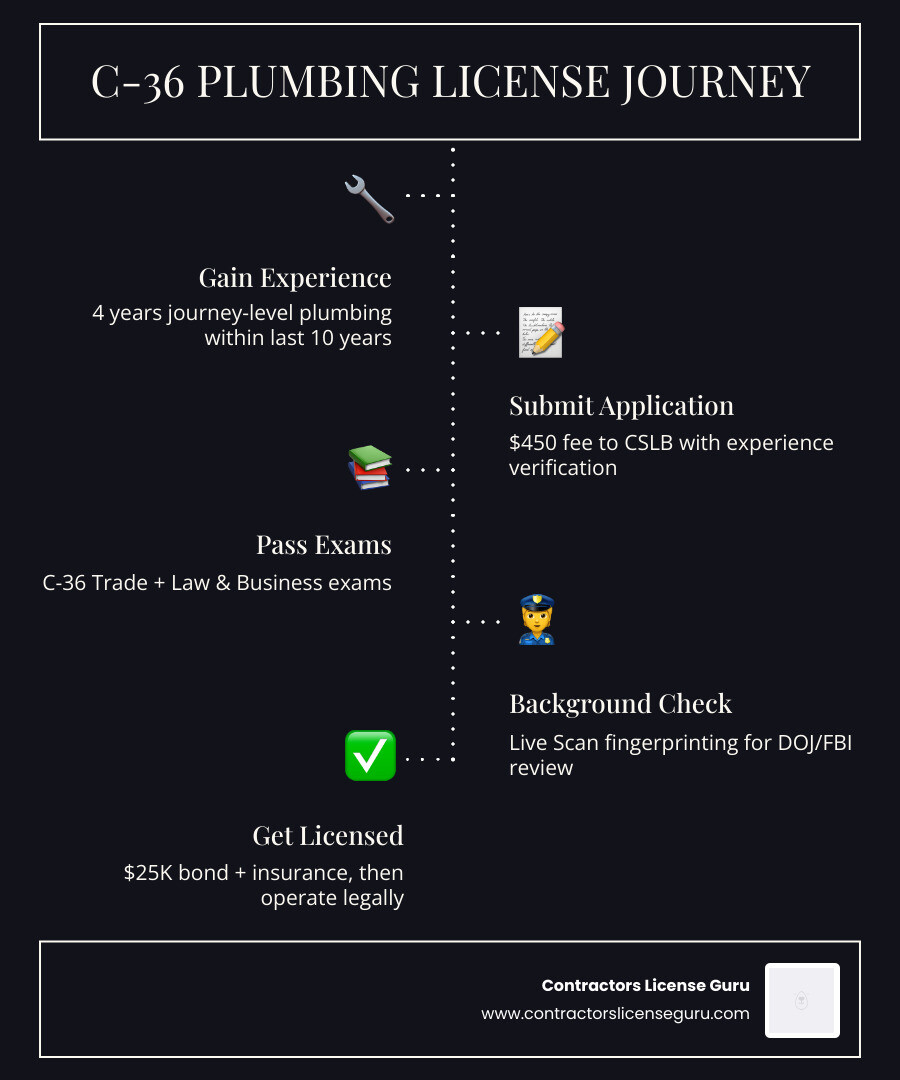
The most common hurdle we see at Contractors License Guru is meeting the experience requirement. To qualify for the California plumbing contractor license, you must demonstrate at least four years of journey-level experience within the last ten years.
What exactly is “journey-level”? The CSLB defines this as a person who has completed an apprenticeship program or is an experienced worker who can perform the trade without supervision. You aren’t just a helper or a laborer; you are a pro who knows the code and the tools.
The CSLB is very strict about how this experience is documented. You must submit a “Certificate of Work Experience” signed by a qualified individual (usually a licensed contractor, a union representative, or an employer) who has knowledge of your skills. If you are self-employed (even if unlicensed), you can sometimes use client references or building permits to prove your time in the field, but this is a much more difficult path.
The demand for these skills is reflected in the U.S. Bureau of Labor Statistics Wage Data. With California plumbers earning a mean wage of $78,350—and many business owners earning significantly more—the four-year investment is well worth it.
Do you have a degree or did you finish a formal apprenticeship? You might be able to shave some time off that four-year requirement. The CSLB allows for educational credits to substitute for up to three years of experience, but you must still have at least one year of actual field experience.
To get this credit, you’ll need to submit official transcripts with your application. We often help our clients determine exactly how much credit they can expect before they hit “send” on their paperwork.
Once you have your four years of experience locked in, it’s time to tackle the paperwork. This is where my background as a former CSLB technician comes in handy. The “Application for Original Contractor License” is a dense document, and the smallest mistake—like a missing signature or a vague description of duties—can result in the CSLB returning your application.

The process looks like this:
If you’re feeling overwhelmed by the forms, we offer more info about licensing services to help ensure your application is “bulletproof” before it reaches the state’s hands.
Every applicant for a California plumbing contractor license must undergo a criminal background check. After your application is accepted, the CSLB will send you a Live Scan packet.
You will need to visit one of the many Accredited Live Scan locations throughout California. There, they will take your digital fingerprints and send them to the Department of Justice (DOJ) and the FBI. The cost for this is usually between $50 and $75.
A criminal record does not automatically disqualify you. The CSLB looks at the nature of the crime, how long ago it happened, and evidence of your rehabilitation. However, you must be honest. Failing to disclose a conviction is often worse than the conviction itself in the eyes of the board.
Before your license can be activated, you have to prove you are financially responsible. This protects the public and your employees.
You can check the CareerOneStop Occupational Profile to see how these requirements fit into the broader plumbing industry landscape.
You’ve got the experience, and the state likes your background. Now, you have to prove what you know. You will be required to pass two separate exams:
Both exams are:
Don’t let the “closed-book” part scare you. Most people who fail these exams do so because they rely only on their field experience. The exams test you on the official code and the legal way to run a business, which isn’t always how things happen on a job site.
We recommend a structured study plan. Use practice tests to get used to the wording of the questions. The CSLB likes to use “distractor” answers that look correct but are technically wrong.
Check out our CSLB Exam Preparation Course Summaries for a breakdown of how we help our students pass on the first try. We focus on teaching you the “CSLB way” of answering questions.
The C-36 exam is divided into five main sections. Knowing where the bulk of the questions come from can help you focus your study time.
Running a licensed business means keeping up with the “membership dues” to the state. Here is a breakdown of what you can expect to pay to get and keep your California plumbing contractor license.
One great thing about California is that there is currently no continuing education requirement to renew your C-36 license. Once you pass the exams, you just need to keep your bond active and pay your fees.
If you are already licensed in another state, you might be in luck. California has limited reciprocity agreements with:
If you have held a valid plumbing license in good standing in one of these states for the last five years, the CSLB may waive the trade portion of the exam. However, you will always have to take the California Law & Business exam. No one gets out of that!
To see how this works in practice, look at our Contractors License Exam Course Overview.
A license isn’t a “set it and forget it” document. To keep your business legal, you must:
Obtaining your California plumbing contractor license is the single most important step you can take to grow your career. It moves you from being an employee to being an entrepreneur. With an 8% projected growth rate and a high demand for skilled trades in cities like Sacramento, the timing has never been better.
Yes, the process is rigorous. The 4-year experience requirement, the $25,000 bond, and the two difficult exams are there to ensure that only the best pros are out there protecting California’s water and gas systems.
At Contractors License Guru, we are here to simplify that journey. Whether you need help with the initial paperwork or you’re looking for Application Assistance and LLC Services, we have the expertise to get you across the finish line.
How long does it take to get a C-36 license? From the moment you mail your application, it typically takes 3 to 5 months. This includes the time for application processing (4-8 weeks), scheduling and passing your exams, and the final issuance of the license number.
What are the penalties for unlicensed plumbing work? In California, contracting without a license is a misdemeanor. A first offense can result in up to six months in jail and a $5,000 fine, plus administrative fines of up to $15,000. A second offense carries a mandatory 90-day jail sentence. It’s simply not worth the risk.
How can I verify a California plumbing contractor’s license? You can use the “Instant License Check” on the CSLB website. You can search by license number, business name, or the name of the individual. This tool will show you if the license is active, if they have the required bonds, and if there are any legal actions against them.
Can I use my overseas experience to qualify? Yes! This is a specialty of ours. If you have plumbing experience from another country, it can often be used to meet the 4-year requirement. However, the documentation must be translated and verified carefully to meet CSLB standards. Reach out to us if you need help with this specific situation.