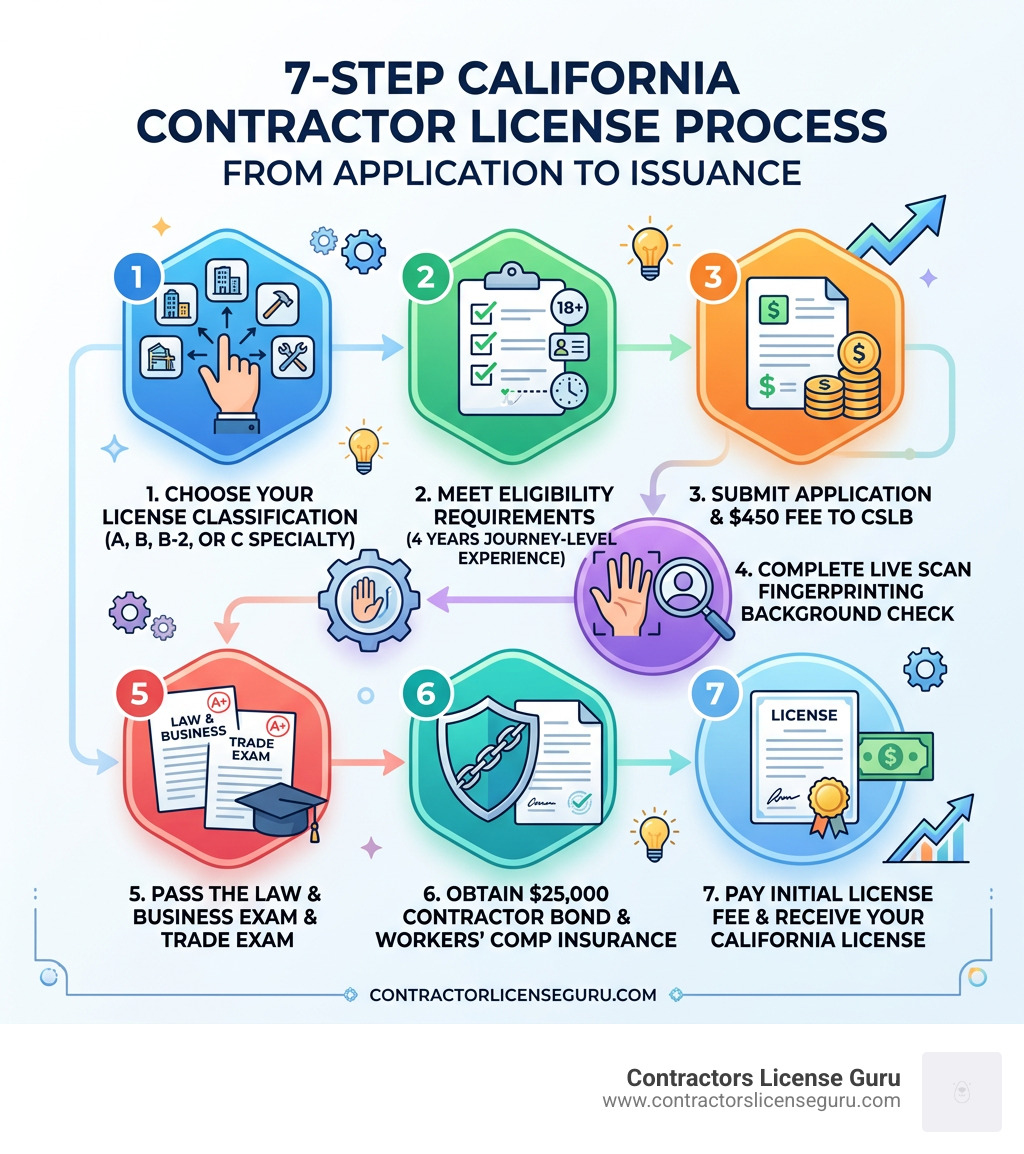
Get your contractor license in California the right way, and you unlock the ability to legally bid on projects, protect your business, and build real credibility. Here’s a quick overview of the process:
The Contractors State License Board (CSLB) licenses and regulates around 285,000 contractors across 45 classifications in California. Any construction project valued at $1,000 or more in combined labor and materials must be performed by a CSLB-licensed contractor. Getting licensed is not just a legal requirement — it protects consumers and gives your business a serious competitive edge.
The process involves several steps, specific fees, exams, and documentation. It can feel overwhelming, especially if you’re navigating it for the first time or dealing with complex situations like overseas experience or exam waivers.
I’m Phil Cocciante, and after five years working directly as a license application technician at the CSLB and over 20 years in the construction industry, I’ve helped thousands of contractors successfully get contractor license approvals. In the sections below, I’ll walk you through everything you need to know — step by step.
In the Golden State, the rules for who needs a license are quite strict. If you are performing any construction, alterations, or improvements where the total cost of the project—including both labor and materials—is $500 or more, you must have a license. However, the CSLB more specifically highlights that any project priced at $1,000 or more (in labor and materials combined) must be performed by a contractor with a CSLB-issued license.
We often get asked about the “handyman” exception. While a handyman can technically work on projects under the $500 threshold without a license, they cannot “break down” a larger project into smaller $499 chunks to circumvent the law. For example, if you’re remodeling a kitchen for $6,000, you can’t claim you’re just doing the $300 flooring portion to avoid licensing; the project is viewed as a whole.
There are also specific steps to becoming a licensed contractor that apply to owner-builders. If you are building on your own property, you might be exempt, but there are strict limits on how many structures you can build and sell within a certain timeframe. Specialty subcontractors—those focusing on a single trade like roofing or HVAC—must also be licensed under their specific trade classification. To see which bucket your work falls into, check out more info about California contractor license classifications.
California breaks down its 45+ licenses into four primary categories. Choosing the right one is the foundation of your application.
To be eligible to get a contractor license in California, you must be at least 18 years old and possess a valid Social Security Number (SSN) or Individual Taxpayer Identification Number (ITIN).
The “meat” of your application is your work experience. You must prove at least four years of journey-level experience within the last 10 years. What does “journey-level” mean? It means you can perform the work without supervision and are fully qualified in your trade.
We can count experience gained as a:
You’ll need to submit a Certification of Work Experience form, signed by someone with knowledge of your work (like a former employer or a fellow contractor).
Don’t have a full four years in the field? You might be able to use education as a substitute. A Bachelor’s degree can sometimes count for up to three years of experience, and vocational training or apprenticeship programs can also provide significant credits. Furthermore, there is expedited military licensure for Skillbridge enrollees and veterans, which can help speed up the background check and application review process.
Once you’ve gathered your experience and chosen your classification, it’s time to face the paperwork. The non-refundable application fee is $450. You can use the Application for Original Contractor License found on the CSLB website.
After we help you submit your application, the CSLB will review it. Be aware that they randomly select 3% of all applications for a detailed audit, where they may ask for payroll records or tax documents to verify your experience. If your application has errors, they will return it for correction, which can add weeks to your timeline.
Once accepted, you’ll receive a packet for Live Scan fingerprinting. This is mandatory for a criminal background check. The CSLB looks at your history to ensure you’re fit for the responsibility of a license. If you’re worried about how a past mistake might affect your chances, we can provide more info about our services and how we help navigate these hurdles.
Unless you qualify for a waiver, you’ll need to pass two exams: the Law and Business exam and the specific Trade exam. These are computer-based tests administered by PSI at various centers across California (and even one in Oregon).
The Law and Business exam covers things like contract law, bookkeeping, safety regulations (OSHA), and labor laws. The Trade exam focuses on your specific craft—everything from codes to technical execution. You have an 18-month window from the time your application is approved to pass these tests. If you fail, there is a 21-day wait before you can retest.
Preparation is key. We offer CSLB exam preparation course summaries designed to cut through the fluff and help you focus on what actually appears on the test.
If English isn’t your first language, don’t worry—the CSLB allows for language translation assistance or the use of a translator for certain exams, and some trade tests are even available in Spanish.
Passing the exam is a huge win, but you aren’t licensed yet! You’ll receive a “Bond and Fee” letter outlining the final requirements.
| Fee Type | Sole Owner | Non-Sole Owner (Corp/LLC/Partner) |
|---|---|---|
| Application Fee | $450 | $450 |
| Initial License Fee | $200 | $350 |
| Total Base Fees | $650 | $800 |
One of the most critical requirements is the contractor’s bond. As of January 1, 2023, the surety bond requirements increased from $15,000 to $25,000. This bond is for the benefit of consumers or employees who might be damaged by your actions.
Additionally, if you have employees, you must have Workers’ Compensation insurance. Even if you don’t have employees, certain classifications like C-39 (Roofing) are required to carry Workers’ Comp regardless. If you are operating as an LLC, you also need an additional $100,000 worker bond and specific levels of liability insurance based on the number of personnel you have.
Once these are submitted and the initial fee is paid, you’ll finally receive your wall certificate and that all-important plastic pocket card.
California has reciprocity agreements with Arizona, Nevada, and Louisiana. This doesn’t mean you just “swap” licenses; it means the CSLB may waive the trade exam if you’ve been licensed in good standing in those states for at least five years.
There are also exam waiver provisions under B&P Code 7065.1. Generally, if you’ve been a qualifier on a license in the same classification within the last five years, you might skip the exams. However, be aware that the Registrar has currently suspended certain waiver provisions (like 7065.1a), so check the current status of the law.
Maintenance is just as important as getting the license. Active licenses must be renewed every two years. If you aren’t currently contracting, you can put your license on “Inactive” status, which requires renewal every four years and doesn’t require bonds or insurance. To stay on top of the rules, we recommend reviewing our contractor license exam course overview periodically.
Typically, it takes 3 to 6 months to get a contractor license in California. This includes 1-2 weeks of prep, 4-6 weeks for CSLB application processing, 2-4 weeks for exam scheduling, and another 4-6 weeks for final issuance after you pass.
Don’t risk it. A first offense is a misdemeanor that can land you in jail for up to six months and cost you $5,000 in fines, plus administrative fines up to $15,000. More importantly, California law uses the “disgorgement” principle—you could be forced to pay back every penny you earned on an unlicensed project, even if the work was perfect. In disaster areas, unlicensed contracting can even be charged as a felony.
Yes! You can get credit for vocational training, apprenticeships, or college degrees. A Bachelor’s degree can give you up to 3 years of credit, meaning you’d only need one year of field experience. You can find a community college with construction programs to start building those credits.
Getting your license is the single best thing you can do for your construction career in California. It moves you from a “guy with a truck” to a professional business owner with legal protections and higher earning potential.
At Contractors License Guru, we take the stress out of the paperwork. Whether you need help documenting your experience, finding the right study materials, or navigating the CSLB’s complex regulations, we are here to help. We’ve been through this thousands of times, and we know exactly what the state is looking for.
Are you ready to build your future? Start your journey with Contractors License Guru today and let’s get your business on the road to long-term success in the thriving California construction industry!
