
Why Getting Your California Contractor License Matters
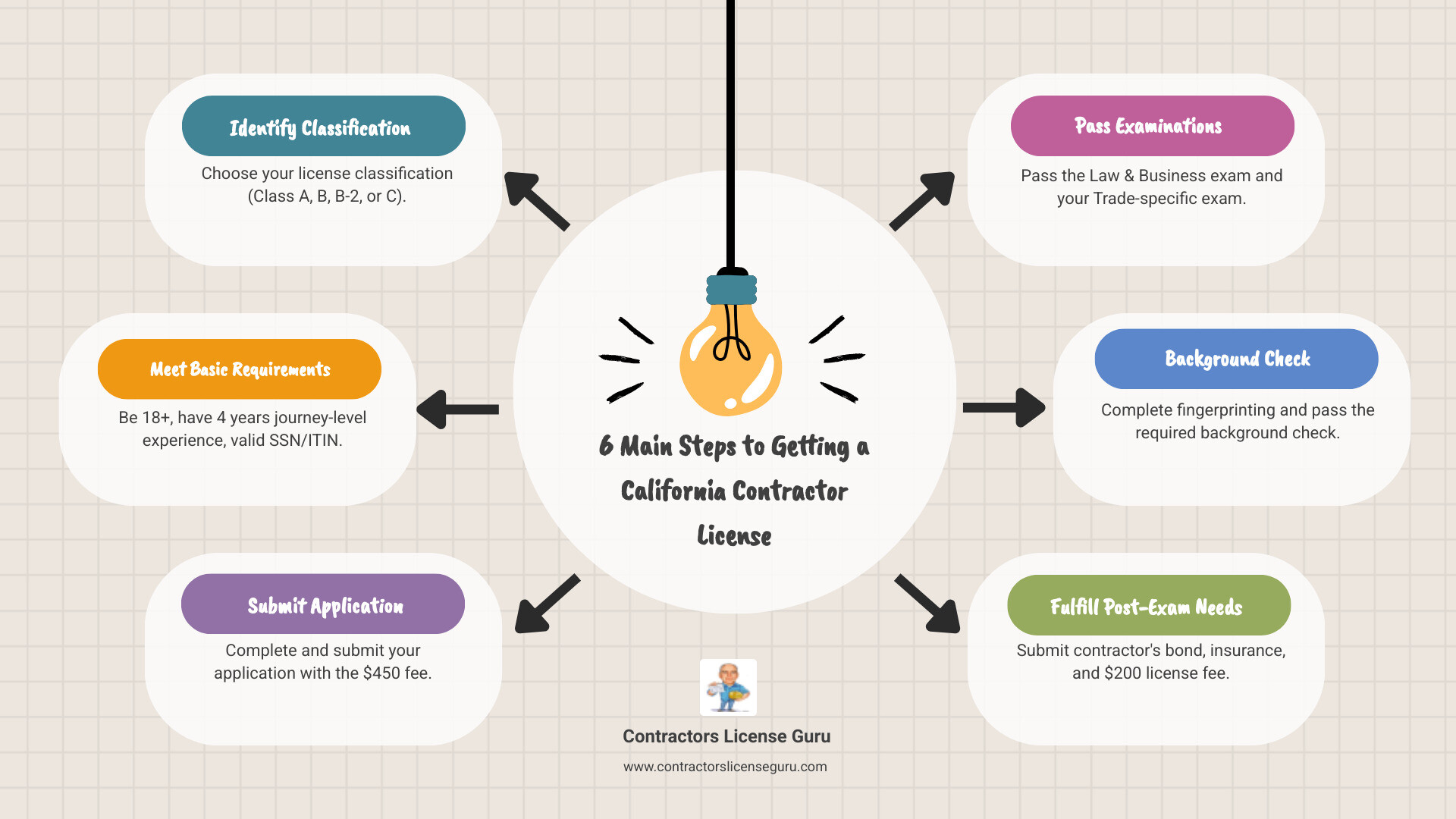
A California contractor license is required for anyone performing construction work valued at more than $500 (including labor and materials) in the state. Here’s what you need to know to get licensed:
Quick Overview: California Contractor License Requirements
- Minimum Age: 18 years old
- Experience Required: 4 years of journey-level experience in your trade
- Exams: Law & Business exam + Trade-specific exam (for most classifications)
- Initial Costs: $699 minimum (application $450 + license $200 + fingerprinting ~$49)
- Bond Required: $25,000 contractor’s bond
- License Duration: 2 years for active licenses, 4 years for inactive
Understanding the licensing process can feel overwhelming, but it follows a clear path. The California Contractors State License Board (CSLB) oversees over 40 license classifications, each with specific requirements.
Working without a license isn’t just risky—it’s illegal. First-time offenders face up to six months in jail and fines up to $5,000, plus administrative penalties from $200 to $15,000. Beyond avoiding penalties, a valid license protects your right to file mechanics liens, pursue payment in court, and build credibility with clients.
I’m Phil Cocciante, and I’ve spent over 20 years helping contractors steer the California contractor license application process, including five years working inside the CSLB as a license application technician. Since founding Contractors License Guru in 2005, I’ve guided thousands of contractors through every step—from determining the right classification to preparing for exams and avoiding common application mistakes.
This guide breaks down the license types, experience requirements, application steps, costs, and more. By the end, you’ll have a clear roadmap to getting licensed and growing your contracting business in California.
Understanding California Contractor License Classifications
One of the first and most crucial steps in obtaining your California contractor license is identifying the correct classification for the work you intend to perform. The Contractors State License Board (CSLB) categorizes licenses into three main classes: Class A (General Engineering), Class B (General Building), and Class C (Specialty). In addition, there’s a specific Class B-2 for Residential Remodeling. Choosing the right classification ensures you’re legally authorized to take on projects and comply with state regulations.
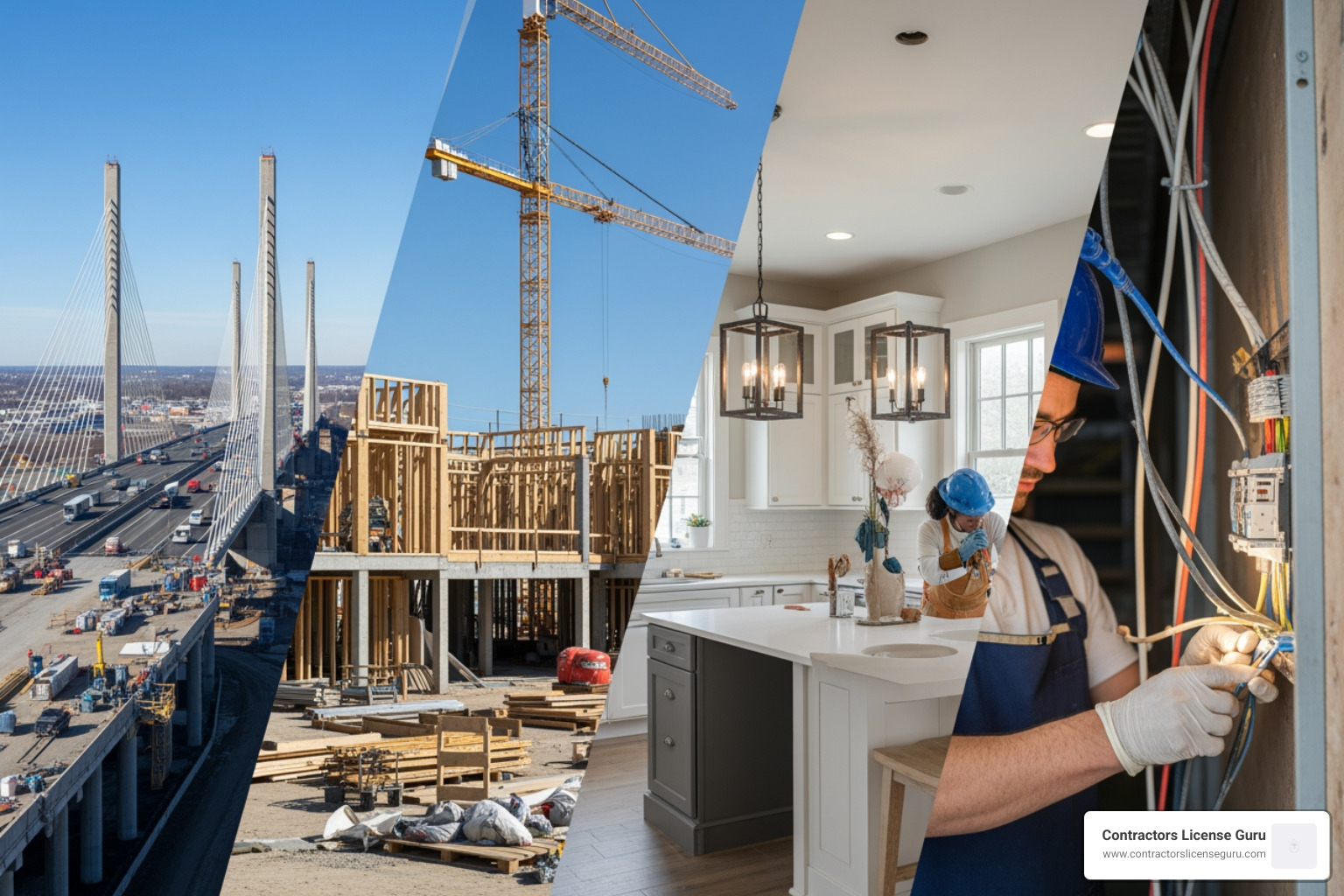
Class A General Engineering License: This license is for contractors working on fixed works requiring specialized engineering knowledge, such as highways, bridges, dams, and airports. If your projects involve extensive earthmoving or complex structural engineering, you’ll likely need a Class A license.
Class B General Building License: The Class B license is for general contractors whose projects involve at least two unrelated building trades. A Class B contractor can oversee a full building project, like a new home, coordinating trades from framing to plumbing.
Class B-2 Residential Remodeling Contractor License: Introduced in 2021, the Class B-2 license is for contractors improving existing residential structures. A project must involve at least three unrelated trades under a single contract. This is ideal for residential remodelers handling projects like kitchen or bathroom renovations that combine plumbing, electrical, and carpentry.
Class C Specialty Contractor License: If you specialize in a particular trade, the Class C license is for you. This classification covers over 40 different categories, each dedicated to a specific craft. These contractors typically work on one specific aspect of a construction project. For example, a Class C contractor might specialize exclusively in plumbing, electrical work, or roofing.
Here’s a list of some common Class C licenses:
- C-10 Electrical Contractor: For installing, repairing, or maintaining electrical systems.
- C-36 Plumbing Contractor: For installing, repairing, or maintaining plumbing systems.
- C-20 Warm-Air Heating, Ventilating and Air-Conditioning (HVAC) Contractor: For installing and servicing heating, ventilation, and air conditioning systems.
- C-39 Roofing Contractor: For installing and repairing roofs.
- C-33 Painting and Decorating Contractor: For applying protective coatings and decorative finishes.
- C-8 Concrete Contractor: For working with concrete, including sidewalks, driveways, and foundations.
- C-27 Landscaping Contractor: For landscape construction, including irrigation systems and planting.
- C-61 Limited Specialty Contractor: This class has numerous sub-categories for highly specialized tasks, and notably, a trade examination is not required for many C-61 classifications.
It’s essential to review the scope of work for each classification to ensure you apply for the correct license. Choosing the wrong one could delay your application or limit the projects you can legally undertake. We at Contractors License Guru can help you find the perfect fit for your business.
The Essential Requirements for a California Contractor License
Before you fill out an application, you must meet fundamental requirements to be eligible for a California contractor license. These criteria ensure that only qualified individuals operate as licensed contractors, protecting consumers and maintaining industry standards.
To apply for a license, you must:
- Be at least 18 years old.
- Possess a valid Social Security Number (SSN) or Individual Taxpayer Identification Number (ITIN).
- Have the necessary experience and skills to manage the daily activities of a construction business, including field supervision.
The Contractors State License Board (CSLB) is the state agency responsible for regulating the construction industry and issuing these licenses.
How much experience is needed for a california contractor license?
One of the most critical requirements is verifiable experience. The CSLB requires applicants to have four years of experience at the journey level, or as a foreman, supervisor, or contractor in their classification. This experience must have been acquired within the past ten years.
Journey-level experience means you have progressed beyond an apprentice level and can perform the tasks of your trade independently and competently, with extensive knowledge and skill.
You must prove your experience with a certifier—a licensed contractor, foreman, supervisor, or client with direct knowledge of your work—who will sign off on your application. The CSLB verifies this information, so ensure your documentation is thorough and credible.
Can education substitute for experience?
Yes. The CSLB recognizes that formal education and training contribute to a contractor’s skill set, allowing you to substitute some required experience with relevant education.
The CSLB may provide credit for up to three years of the four-year experience requirement for vocational training or an applicable Division of Apprenticeship Standards approved apprenticeship program.
Beyond vocational training, academic degrees can also count:
- Associate of Arts (AA) or Science (AS) degree: You can receive credit for up to 1.5 years if your degree is in a construction-related field.
- Bachelor’s degree: A bachelor’s degree in a CSLB-approved field like construction management or civil engineering can substitute for up to three years of experience.
The CSLB evaluates educational documentation on a case-by-case basis. If you’re considering this path, you can research programs at community colleges or private schools. This flexibility allows a broader range of skilled individuals to pursue their California contractor license.
Your Step-by-Step Guide to the Application Process
Navigating the application process for a California contractor license can seem complex, but we’re here to clarify each step, from submitting paperwork to fulfilling post-exam requirements.
Step 1: Complete and Submit Your Application
Your journey begins with the “Application for Original Contractor’s License,” available on the CSLB website.
Here’s what you need to do:
- Fill out the application thoroughly: Provide all required personal, business entity, and detailed work experience information. Your certifier must sign the experience verification section.
- Pay the application fee: The non-refundable application fee is $450 and must accompany your application.
- Mail your application: Send your completed application and fee to the CSLB Headquarters in Sacramento.
The CSLB will review your application for completeness. If it’s accepted, you’ll receive a notice to schedule your exams. You can check your application status on the CSLB’s website.
Step 2: Prepare for and Pass the Examinations
After your application is accepted, you’ll schedule your exams. Most contractor license classifications require passing two exams:
- Law and Business Exam: This exam covers construction law, contracts, safety regulations, and business practices. It typically has around 115 multiple-choice questions with a 3.5-hour time limit.
- Trade-Specific Exam: This exam tests your practical knowledge for your chosen classification (e.g., plumbing, electrical). It’s usually a similar format to the Law and Business exam. Some C-61 Limited Specialty classifications do not require a trade exam.
Scheduling Your Exams: You’ll schedule your exams with PSI, the CSLB’s testing provider. Schedule them as soon as you receive your eligibility notice and arrive 15-30 minutes early on test day with a valid photo ID.
Preparing for Exams: Preparation is key. While the CSLB provides study guides, many applicants benefit from comprehensive exam prep courses. At Contractors License Guru, we offer CSLB exam preparation courses to equip you with the necessary knowledge. Watching the CSLB’s What to Expect on Test Day video can also help you prepare.
Exam Waivers: You might be eligible for an exam waiver under certain conditions outlined in Business and Professions (B&P) Code sections 7065.1 and 7065.2. For example, if you were a qualifier on a license in good standing for the same classification within the last five years. However, waiver availability can change, so it’s crucial to check current CSLB policies.
Step 3: Fulfill Post-Exam Requirements
Congratulations on passing your exams! A few more steps are needed before your California contractor license is issued.
- Initial License Fee: Pay the $200 initial license fee, which covers your license for the first two years.
- Contractor’s Bond: All licensed contractors must have a $25,000 contractor’s bond to protect consumers.
- Bond of Qualifying Individual (QII Bond): If your license is qualified by an RME or RMO, an additional $15,000 Bond of Qualifying Individual is required.
- LLC Employee/Worker Bond: LLC licenses require an additional $100,000 LLC Employee/Worker Bond.
- Proof of Workers’ Compensation Insurance: You must provide proof of workers’ comp if you have employees.
- Liability Insurance: LLCs are required to carry liability insurance, and it’s a best practice for all contractors.
- Fingerprinting and Background Check: You must undergo a criminal background check via Live Scan fingerprinting (fee is ~$49). The CSLB reviews convictions on a case-by-case basis.
- Asbestos Open Book Exam Verification: You must complete an open book asbestos exam and submit the verification form to the CSLB.
Once all requirements are met, the CSLB will issue your California contractor license, signifying your readiness to operate legally and professionally in California.
Costs, Renewals, and Other Financial Considerations
Understanding the financial commitment for your California contractor license is crucial for planning. While it’s an investment, the benefits of being licensed far outweigh the costs.
Here’s a breakdown of typical fees:
| Item | Cost | Frequency/Notes |
|---|---|---|
| Application Fee | $450 | One-time, non-refundable |
| Initial License Fee | $200 | One-time, covers first two years |
| Fingerprinting Fee | ~$49 | One-time, can vary slightly by Live Scan provider |
| Exam Reschedule Fee | $60 | Per exam, if you need to reschedule |
| Contractor’s Bond | $25,000 | Bond amount; annual premium varies (e.g., 1-5% of bond) |
| Bond of Qualifying Individual (QII) | $15,000 | Bond amount; annual premium varies |
| LLC Employee/Worker Bond | $100,000 | Bond amount; annual premium varies |
| Active License Renewal | $450 | Every two years (if timely) |
| Inactive License Renewal | $225 | Every four years (if timely) |
| Late Active Renewal | $675 | If renewal is late |
| Late Inactive Renewal | $337 | If renewal is late |
Beyond these fees, you must also budget for bond premiums and liability insurance. A bond premium is an annual fee paid to a surety company, which varies based on your credit. Liability insurance premiums depend on your coverage and business type.
License Renewal: Your active California contractor license is valid for two years, while inactive licenses expire every four years. It’s vital to renew on time to avoid higher fees. A timely active renewal is $450, but a late one is $675. We recommend setting reminders well in advance to ensure you renew promptly!
Navigating Special Cases: Exceptions, Penalties, and Reciprocity
While most applicants follow the same path, there are specific exceptions and severe consequences for non-compliance that all contractors should understand.
Licensing exceptions
The most common exception is the “$500 rule,” which states that any project valued over $500 (including labor and materials) requires a license. This means minor handyman tasks below this threshold may not require a license. However, you cannot break down a larger project into multiple sub-$500 jobs to avoid licensing. If the total project cost exceeds $500, all contractors involved need a license, regardless of their individual contract amount. It’s always safer to be licensed.
Penalties for unlicensed contracting
Working in California without a valid license is illegal and carries severe penalties. The CSLB actively pursues unlicensed contractors.
- Financial Penalties: Unlicensed contractors cannot sue a client for non-payment and may be forced to return all payments received (disgorgement). Administrative fines range from $200 to $15,000.
- Criminal Penalties:
- First Offense: A misdemeanor with up to six months in jail and/or a $5,000 fine.
- Second Offense: A mandatory 90-day jail sentence and a fine of 20% of the contract price or $5,000, whichever is greater.
- During a State of Emergency: Unlicensed work during a declared state of emergency is a felony.
We strongly advise against operating without the proper California contractor license.
Can a contractor’s license be transferred from another state?
Not directly, but California has reciprocity agreements with a few states that can expedite the process. These agreements can waive the trade exam for qualified individuals.
Currently, California offers reciprocity with:
- Arizona
- Nevada
- Louisiana
To qualify, you must have held a license in good standing in one of these states for the previous five years. You will still be required to pass the California Law and Business exam. The CSLB will verify your license history and experience, making your path to a California contractor license smoother, but it doesn’t bypass all California requirements.
Additional Registrations and Important CSLB Alerts
Beyond the core california contractor license, other registrations and CSLB alerts are crucial for compliance and avoiding scams.
Home Improvement Salesperson (HIS) registration
If you are employed by a licensed contractor to sell or negotiate home improvement contracts, you need a Home Improvement Salesperson (HIS) registration. This is separate from a contractor’s license and is for individuals in a sales role.
- HIS Requirements: The registration is for individuals working for a licensed contractor in a sales capacity.
- HIS Application Process: You submit an application and fee to the CSLB for a two-year registration.
- Contractor’s Responsibility: The employing contractor must notify the CSLB when they hire or part ways with a registered HIS.
CSLB scam alerts
The CSLB is vigilant about protecting consumers and contractors from fraud and frequently issues scam alerts.
- Impersonation Emails, Texts, and Calls: Scammers may send fraudulent communications pretending to be from the CSLB. Always verify the sender’s email address; official CSLB communications come from a
@cslb.ca.govdomain. Report suspicious emails to CSLBinfo@cslb.ca.gov. - Down Payment Rules: For home improvement, residential solar, ADUs, or disaster rebuilding projects, the down payment cannot exceed $1,000 or 10% of the contract price, whichever is less. This rule protects consumers from excessive upfront payments.
Expedited licensure for military members
California supports military service members transitioning into civilian careers. The CSLB offers expedited licensure application processing for service members enrolled in Skillbridge and other assistance programs. This initiative fast-tracks the application review for eligible individuals. If you are a service member, these programs can significantly reduce the time it takes to get your California contractor license.
Conclusion
Obtaining your california contractor license is a significant milestone that opens up vast opportunities. We’ve walked through the essential steps, from understanding license classifications (Class A, B, B-2, and C specialties) to meeting the four-year experience requirement.
We’ve detailed the application process, from submitting paperwork and passing exams to securing your contractor’s bond and insurance. Understanding the costs, renewal schedules, and severe penalties for unlicensed work is key to running a compliant business. We also covered special cases like reciprocity and the need for HIS registration.
The path to licensure is manageable with careful planning. A California contractor license grants you legal authority to operate, provides professional credibility, protects your lien rights, and shows clients your commitment to quality.
At Contractors License Guru, we’ve dedicated ourselves to simplifying this journey. We offer comprehensive support, from application services to study guides and practice exams, leveraging our deep expertise with the CSLB. Ready to take the next step? Explore our resources and get a complete guide to the California contractor license process today.