California C20 License: Everything You Need to Know for HVAC Contractors

Why the CSLB C20 License is Essential for HVAC Contractors

The CSLB C20 license is California’s specialty contractor license for warm-air heating, ventilating, and air-conditioning (HVAC) professionals. Here’s what you need to know:

Quick Facts:

  • Required for: HVAC projects over $500 in labor and materials
  • Covers: Fabrication, installation, maintenance, servicing, and repair of heating, ventilation, and AC systems
  • Basic requirements: 18+ years old, 4 years of journeyman experience, pass two state exams
  • Total cost: $799-$949 (application, exams, bond, fingerprinting, license fee)
  • Timeline: 15-90 days after passing exams, plus 6-8 weeks for application processing

California law requires anyone performing HVAC work valued at more than $500 to hold a valid C20 license from the Contractors State License Board (CSLB). This isn’t just a bureaucratic formality, it’s a critical credential that protects consumers, ensures public safety, and opens doors to legitimate business opportunities in a growing industry. According to the US Bureau of Labor Statistics, employment of HVAC mechanics and installers is expected to rise by 5% between 2020 and 2030.

Without this license, you cannot legally bid on residential or commercial HVAC projects, and you risk serious penalties including fines and criminal charges. With it, you gain credibility, access to larger contracts, and the ability to build a legitimate, profitable business.

The path to obtaining your C20 license involves meeting experience requirements, passing two state examinations, securing a surety bond, and completing several administrative steps. While the process can seem overwhelming, understanding each requirement and preparing properly makes it manageable.

I’m Phil Cocciante, owner of Contractors License Guru and former CSLB application technician with over 20 years of construction industry experience. I’ve helped thousands of contractors successfully steer the CSLB C20 license application process, from verifying experience to determining exam waivers and ensuring every form is completed correctly.
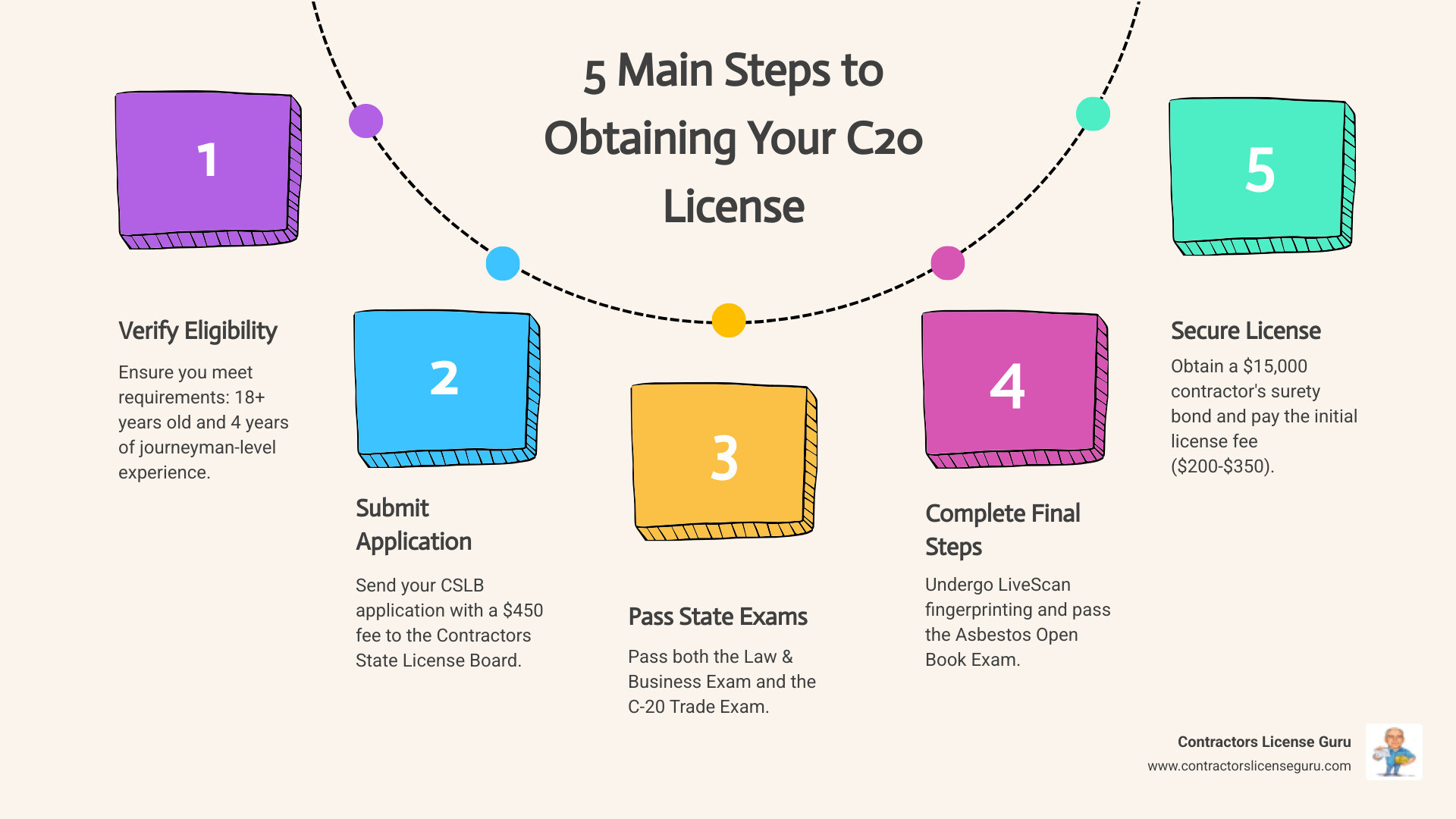
Infographic showing the 5 main steps to obtaining a C20 license: 1) Verify you meet eligibility requirements (18+, 4 years experience), 2) Submit CSLB application with $450 fee, 3) Pass Law & Business and C-20 Trade exams, 4) Complete fingerprinting and Asbestos exam, 5) Obtain $15,000 bond and pay license fee ($200-$350) - CSLB C20 license infographic process-5-steps-informal

What is a CSLB C20 License and Why is it Essential?

The CSLB C20 license is California’s specific classification for a Warm-Air Heating, Ventilating, and Air-Conditioning Contractor. It’s not just a piece of paper; it’s your official pass to legally operate and excel in the HVAC industry within the Golden State. The Contractor State License Board (CSLB) defines a C-20 HVAC contractor as someone who fabricates, installs, maintains, services, and repairs warm-air heating systems, ventilating systems, and air-conditioning systems. This includes all related components and controls.

Why is this so crucial? Because HVAC systems are complex and directly impact public safety, comfort, and energy efficiency. The CSLB ensures that only qualified professionals undertake this critical work. If you plan to bid on residential or commercial heating, ventilation, or air conditioning projects with a labor and material cost of more than $500, this license isn’t optional – it’s a legal requirement. Operating without it can lead to severe penalties, including fines and even criminal charges, not to mention putting your clients at risk.

The C-20 license is regarded as one of the most important licenses in public safety because it covers a broad range of technicalities. It assures consumers that you’ve met strict state standards, enhancing your credibility and opening doors to larger, more lucrative projects. For a deeper dive into what this license means for your career, check out our guide: A Complete Guide to the C20 License for HVAC Contractors in California.

The Scope of a C-20 HVAC Contractor

So, what exactly can you do with a CSLB C20 license? The scope is quite extensive! A C-20 contractor is authorized to handle the fabrication, installation, maintenance, servicing, and repair of a wide array of systems and components. This includes:

  • Warm-air heating systems
  • Water heating heat pumps
  • Ventilating systems with blowers and plenum chambers
  • Air-conditioning systems complete with air-conditioning units
  • All related components such as ducts, registers, flues, humidity controls, thermostatic controls, and air filters.

Interestingly, this classification also explicitly includes systems that use solar energy for heating, ventilating, and air-conditioning functions. This means you’ll be well-equipped to handle modern, energy-efficient installations that are increasingly in demand across California. For the official word, you can always refer to the CSLB’s official definition of classifications.

General vs. Specialty Contractor: Where the C-20 Fits

In California, contractor licenses are broadly categorized into General Engineering (Class A), General Building (Class B), Residential Remodeling (Class B-2), and Specialty (Class C) classifications. The CSLB C20 license falls squarely into the Specialty Contractor (Class C) category.

A General Engineering Contractor (Class A) typically works on “fixed works” like roads, bridges, and pipelines, requiring specialized engineering knowledge. A General Building Contractor (Class B) works on structures that require at least two unrelated building trades or crafts to complete, often overseeing entire projects and coordinating subcontractors. They can contract for and oversee specialty work without holding every specific specialty license, as long as the job involves more than two types of work on a building.

However, a Specialty Contractor, like a C-20 HVAC contractor, focuses on a specific trade requiring special skill. Our C-20 license means we are experts in HVAC systems and our work is confined to this specialized field. While a General Contractor might oversee an entire home renovation, they would typically subcontract the complex HVAC work to a licensed C-20 professional like us. This clear distinction ensures that specialized work is performed by those with proven expertise, maintaining high standards of quality and safety.

C20 License Eligibility and Experience Requirements

Contractor reviewing blueprints - CSLB C20 license

Before you can even dream of holding that shiny CSLB C20 license, you need to meet some fundamental eligibility criteria. The CSLB isn’t just handing these out like candy at a parade; they want to ensure you’re a serious, qualified professional.

Here are the basic requirements:

  • Age Requirement: You must be at least 18 years old.
  • Identification: Possess a valid USA-issued identification.
  • Taxpayer ID: Have a Social Security Number (SSN) or Individual Taxpayer Identification Number (ITIN).
  • Clean Record (mostly): While not an outright disqualifier, you should ideally not be on probation or parole. The CSLB will review any criminal history based on the nature, severity, time since conviction, and evidence of rehabilitation.
  • Experience is King: This is the big one. You need to demonstrate at least four years of journey-level experience in the HVAC trade within the last ten years.

“Journey-level experience” means you’ve gained hands-on experience and skill in the trade, typically working unsupervised, or supervising others, and performing the tasks expected of a skilled worker. It’s about showing you’ve been in the trenches, not just watching from the sidelines.

The CSLB is quite strict about the detail required in the experience certification. You’ll need a qualified individual (like a former employer, foreman, union representative, or even another licensed contractor) to sign off on your experience, providing a detailed description of your capabilities. It’s a good idea to gather supporting documentation like contracts, check stubs, invoices, or tax returns to back up your claims. This helps us ensure your application is rock-solid. For more details on navigating these requirements, you can read our article: Demystifying the C20 License: What to Know.

Can Education Substitute for Experience?

Good news for those with formal training! While four years of journey-level experience is the standard, the CSLB does allow education to substitute for a portion of this requirement. This can be a huge help in shortening your path to a CSLB C20 license.

You can typically substitute up to three years of the required four years of experience with education from an accredited school, technical training, or a completed apprenticeship program. However, there’s a catch (isn’t there always?): you’ll need to provide written documentation. This isn’t a simple “trust me, I went to school” situation. The CSLB will review each case individually, so ensure your transcripts and program descriptions are thorough and clearly demonstrate relevant HVAC training.

General high school coursework generally doesn’t count towards this substitution. We’re talking about specialized vocational or college-level programs directly related to HVAC. If you’ve completed an apprenticeship, especially one recognized by the Division of Apprenticeship Standards, you’re likely in a strong position to claim significant credit towards your experience. We can help you identify what documentation will best support your educational background.

The Step-by-Step Path to Your C20 License

CSLB exam study guide - CSLB C20 license

Obtaining your CSLB C20 license is a journey, not a sprint. It involves a series of carefully executed steps, from submitting your initial application to passing rigorous exams and fulfilling final requirements. Let’s walk through it together.

The entire process, from application submission to receiving your license, can take several months. Typically, after you submit your application, the CSLB takes about six to eight weeks to process it. Once approved, you’ll usually wait another three to four weeks to schedule your examination. After successfully passing both exams, it can still take anywhere from 15 to 90 days for your license to be officially issued. Patience is definitely a virtue here!

Step 1: Submitting Your CSLB Application

Your first official move is to get your application into the hands of the CSLB. This involves completing the “Application for Original Contractor’s License.” You can often fill out the form online, then print and mail it, or request a form directly from the CSLB.

A critical part of this step is accurately certifying your work experience. This means detailing your four years of journey-level HVAC experience within the last ten years. You’ll need a “qualifier” – someone who can attest to your experience and skills – to sign off on your application. This person should be knowledgeable about your work and able to provide a detailed description of your capabilities. We often advise our clients to gather as much supporting documentation as possible, such as pay stubs, invoices, or contracts, to strengthen their application.

Don’t forget the application fee! The original application fee for the entrance exam (for one classification) is $450. Once everything is carefully filled out and double-checked, you’ll mail your complete application packet, along with the fee, to the CSLB’s Headquarters located at 9821 Business Park Drive, Sacramento, CA 95827.

Step 2: Preparing for and Passing the State Exams

Once your application is approved, the CSLB will notify you to schedule your examinations. Yes, “examinations” plural! There are two main tests you must pass to earn your CSLB C20 license:

  1. The Law & Business Exam: This exam covers the legal and business aspects of running a contracting company in California. It has eight major subjects: Business Organization, Business Finance, Employment Requirements, Bonds, Insurance and Liens, Contract Requirements and Execution, Licensing Requirements, and Safety and Public Works. It’s all the stuff that keeps your business above board and running smoothly.
  2. The C-20 Trade Exam: This is your technical HVAC knowledge test. It’s divided into four major sections:
    • Planning and Estimating (25%)
    • Fabrication, Installation, and Startup (29%)
    • Troubleshooting, Repair, and Maintenance (24%)
    • Safety (22%)

Both exams are closed-book, multiple-choice tests. A calculator will be provided for any mathematical computations needed. Our best advice? Study diligently! Many applicants prepare through classes, online programs, and review centers. The CSLB also provides study guides with content outlines and sample questions that are invaluable resources.

We highly recommend utilizing specialized study materials to prepare effectively. You can find more information on preparing for these crucial tests in our articles: HVAC License Exam: Become HVAC Contractor California and Passing the California C-20 License Exam: What to Expect, How to Prepare. We also offer comprehensive study materials for the C20 HVAC Contractors License. To get a visual sense of what test day will be like, you can watch the CSLB’s What to Expect on Test Day video.

Step 3: Finalizing Your License

Congratulations, you passed the exams! You’re almost there. After receiving notification of your passing scores, there are a few final steps to complete before your CSLB C20 license is officially issued:

  • LiveScan Fingerprinting: You’ll need to undergo a criminal background check via LiveScan fingerprinting. The estimated cost for this is around $75.
  • Asbestos Open Book Exam: Yes, another exam! But this one is open-book and focuses on asbestos awareness and safety. You’ll complete it and submit a verification form.
  • Contractor’s Surety Bond: This is a financial guarantee that protects your clients from damages due to poor workmanship or license violations. You’re required to secure a $15,000 contractor’s surety bond. The good news is that the annual premium for this bond may only cost you around $100.
  • Initial License Fee: Once all other requirements are met, you’ll pay an initial license activation fee. This is $200 if you are a sole owner and $350 if you are a non-sole owner (e.g., corporation, LLC, partnership).
  • Workers’ Compensation Insurance: As of January 1, 2023, workers’ compensation insurance is mandatory for all C20 HVAC companies, regardless of whether you have employees or not. This is a critical piece of protection for both you and any potential workers.

Once these steps are completed, the CSLB will issue your license, and you’ll officially be a licensed C-20 HVAC contractor in California!

Breaking Down the Costs and Ongoing Responsibilities

Understanding the financial investment required to obtain and maintain your CSLB C20 license is crucial for proper business planning. While the exact figures can fluctuate slightly, we can provide you with a clear breakdown of the typical costs involved.

Here’s a summary of the common expenses:

  • Application Fee: The original application fee for the entrance exam (covering one classification) is $450.
  • Initial License Activation Fee: After passing your exams, you’ll pay $200 if you’re a sole owner, or $350 for non-sole owners (like partnerships, LLCs, or corporations).
  • Exam Retake Fee: If you need to retake an exam, there’s typically a $100 fee per exam.
  • Contractor’s Surety Bond: A $15,000 surety bond is required, which usually costs around $100 annually.
  • LiveScan Fingerprinting: The estimated cost for LiveScan fingerprinting is $75.
  • Workers’ Compensation Insurance: This is mandatory for all C20 HVAC companies. Costs vary widely depending on your business size, payroll, and claims history.
  • General Liability Insurance: While not always mandated by the CSLB, general liability insurance is highly recommended to protect your business from potential claims. Costs also vary.
  • Exam Preparation Courses/Materials: These costs can range from a few hundred dollars to over a thousand, depending on the provider and format (e.g., online courses, in-person classes, study guides).

These are estimated costs. We always advise consulting with insurance agents for precise quotes on bonds and insurance policies.

How to Maintain Your CSLB C20 License

Getting your CSLB C20 license is a significant achievement, but it’s not a one-and-done deal. Maintaining your license requires ongoing attention and adherence to CSLB regulations. Think of it like keeping your HVAC systems in top shape – regular maintenance is key!

Here’s what you need to do:

  • License Renewal: Your CSLB license typically needs to be renewed every two years. The CSLB will send you a renewal notice well in advance, but it’s always good practice to keep track of your expiration date.
  • Maintaining Your Surety Bond: You must continuously maintain your $15,000 contractor’s surety bond. If your bond lapses or is canceled, your license will be suspended.
  • Proof of Insurance: Keep your Workers’ Compensation insurance active and provide proof to the CSLB as required. If you have employees, this is non-negotiable. General liability insurance, though often optional for the CSLB, is crucial for protecting your business.
  • Updating Business Information: Any changes to your business address, contact information, or business structure must be promptly updated with the CSLB. This ensures you receive important communications and remain compliant.
  • Adhering to CSLB Regulations: Always operate within the scope of your license and follow all state and local building codes, safety regulations, and consumer protection laws. The CSLB has a robust enforcement division, and violations can lead to disciplinary action, including license suspension or revocation.
  • Continuing Education: While not strictly mandated for CSLB license renewal at this time, engaging in continuing education is a best practice. The HVAC industry is constantly evolving with new technologies and energy efficiency standards. Staying current ensures you remain competitive and provide the best service to your clients.

By diligently fulfilling these ongoing responsibilities, you’ll ensure your CSLB C20 license remains active, allowing your business to thrive legally and professionally.

The Benefits of Becoming a Licensed C20 Contractor

So, you’ve put in the hard work, steerd the application, passed the exams, and secured your CSLB C20 license. Was it worth it? Absolutely! The benefits of becoming a licensed C-20 contractor in California are substantial, impacting every aspect of your career and business.

Here’s why this license is a game-changer:

  • Legal Operation: This is the most fundamental benefit. With your C-20 license, you can legally bid on and perform HVAC projects valued over $500. This eliminates the risk of hefty fines, legal troubles, and even potential jail time associated with unlicensed contracting.
  • Bidding on Larger Projects: Licensing opens the door to bigger, more complex, and often more profitable residential and commercial projects. Many clients, especially commercial ones, will only consider licensed contractors, giving you access to a broader market.
  • Increased Credibility and Trust: A CSLB license is a badge of professionalism. It signals to potential clients that you’ve met the state’s rigorous standards for experience, knowledge, and financial responsibility. This builds trust and gives you a significant competitive edge.
  • Higher Earning Potential: Licensed contractors generally command higher rates for their services. Your expertise is recognized and valued, allowing you to price your services more competitively and increase your overall income.
  • Business Growth and Expansion: With a legitimate license, you can confidently grow your business, hire employees, and expand your service offerings. You can advertise your services openly and build a reputable brand.
  • Consumer Protection: As a licensed contractor, you’re part of a system designed to protect consumers. This means your clients have recourse through the CSLB if issues arise, which further builds confidence in your services.
  • Industry Demand: The HVAC industry is experiencing significant growth. According to the US Bureau of Labor Statistics, employment of heating, air conditioning, and refrigeration mechanics and installers is expected to rise by 5% between 2020 and 2030. This rising demand, coupled with California’s diverse climate and focus on energy efficiency, means licensed HVAC professionals will continue to be in high demand.

Your CSLB C20 license transforms you from a skilled technician into a recognized professional, open uping a world of opportunity and stability for your career and business.

Frequently Asked Questions about the CSLB C20 License

We hear a lot of questions about the CSLB C20 license process. Here are some of the most common ones, answered to help clarify your path.

What are the sections of the C-20 Trade Exam?

The Warm-Air Heating, Ventilating and Air-Conditioning (C-20) Examination is a comprehensive test designed to assess your technical expertise. It’s divided into four major sections, each with a specific weighting to reflect its importance in the trade:

  • Planning and Estimating (25%): This section covers job site evaluation, plan interpretation, load and psychrometric calculations, duct system design, and estimating materials and labor.
  • Fabrication, Installation, and Startup (29%): Here, you’ll be tested on equipment installation, electrical and mechanical components, plumbing and refrigeration components, air distribution, and system startup procedures.
  • Troubleshooting, Repair, and Maintenance (24%): This involves diagnostic tests, system maintenance, and repair of heating, ventilating, and air conditioning systems.
  • Safety (22%): This crucial section covers personal protective equipment (PPE), job site safety requirements (including Cal/OSHA regulations), and handling hazardous materials.

Understanding these sections and their weightings is key to focusing your study efforts effectively.

What happens if I work without a CSLB C20 license?

Operating as an HVAC contractor in California without a valid CSLB C20 license for projects exceeding $500 in labor and materials is a serious offense. The CSLB has a robust enforcement division, and the consequences can be severe:

  • Misdemeanor Charges: Unlicensed contracting is a misdemeanor in California.
  • Fines: You could face substantial administrative fines, typically ranging from $200 to $15,000, and potentially criminal fines.
  • Jail Time: In some cases, repeat offenders or those involved in particularly egregious violations could face jail time.
  • Inability to Enforce Contracts: Legally, you cannot sue to collect payment for work performed while unlicensed, even if you did a perfect job.
  • Risk to Consumers: Without a license, you lack the required bond and insurance, leaving consumers vulnerable and potentially liable for damages or injuries. This is why the CSLB strongly advises consumers to only hire licensed contractors.

It’s simply not worth the risk. Getting licensed protects both you and your clients.

Do I need an EPA certification with my C20 license?

Yes, if your work involves handling refrigerants, you absolutely need an EPA Section 608 Certification in addition to your CSLB C20 license. This is a federal requirement, not a state one, enforced by the Environmental Protection Agency (EPA) under the Clean Air Act.

Refrigerants, used in most air conditioning and refrigeration systems, are ozone-depleting substances or potent greenhouse gases. The EPA 608 certification ensures that technicians are properly trained to handle these substances responsibly to prevent harmful releases into the atmosphere.

There are different types of EPA 608 certifications:

  • Type I: For servicing small appliances (e.g., refrigerators, window AC units).
  • Type II: For servicing or disposing of high-pressure appliances (e.g., residential and light commercial AC units).
  • Type III: For servicing or disposing of low-pressure appliances (e.g., chillers).
  • Universal: Covers all types of equipment.

Most C-20 HVAC contractors will need at least a Type II or Universal certification, as residential and commercial HVAC systems typically involve high-pressure refrigerants. This certification demonstrates your commitment to environmental responsibility and safe handling practices, complementing your state license perfectly.

Conclusion: Take the Next Step in Your HVAC Career

The journey to obtaining your CSLB C20 license might seem challenging, but it’s an investment that pays dividends for years to come. This essential credential is your key to open uping legal operation, improved credibility, and significant growth opportunities in California’s thriving HVAC industry. It transforms your skills into a recognized, valuable, and protected profession.

We understand that navigating the CSLB application process, experience verification, and exam preparation can feel like a maze. That’s where we come in. As experts in CSLB licensing, we’re here to guide you through every step, ensuring you have the knowledge and resources to succeed.

Don’t let the process intimidate you. Take control of your career and secure your future as a licensed HVAC contractor. Learn more about how to get a contractor’s license in California and let us help you take that next crucial step. Your success is our business!

Share this post:

Let's Chat with the License Guru

Have questions? Contact Us.

Scroll to Top