A contractor license application is your gateway to legally operating a contracting business in your state. Here’s what you need to know to get started:
Quick Overview: Contractor License Application Essentials
Nearly half of all contractor license applications submitted to the California Contractors State License Board (CSLB) are incomplete or inaccurate and must be returned for correction. These delays can last weeks or months and may even result in your application being abandoned and your fees forfeited.
The good news? Getting your contractor license application right the first time is completely achievable when you understand the requirements and follow the proper steps.
Whether you’re applying for your first license in California or expanding your classifications, the process involves meeting experience requirements, completing detailed paperwork, passing examinations, and securing the proper bonds and insurance. Each state has its own rules—New York City charges a $300 registration fee with a 3-year term, Philadelphia requires a $126 license fee, and New Jersey charges $110 for home improvement contractor registration.
I’m Phil Cocciante, and I’ve spent over 20 years helping contractors steer the contractor license application process, including five years working inside the CSLB as a license application technician. I’ve reviewed thousands of applications and know exactly what it takes to get yours approved quickly and correctly.
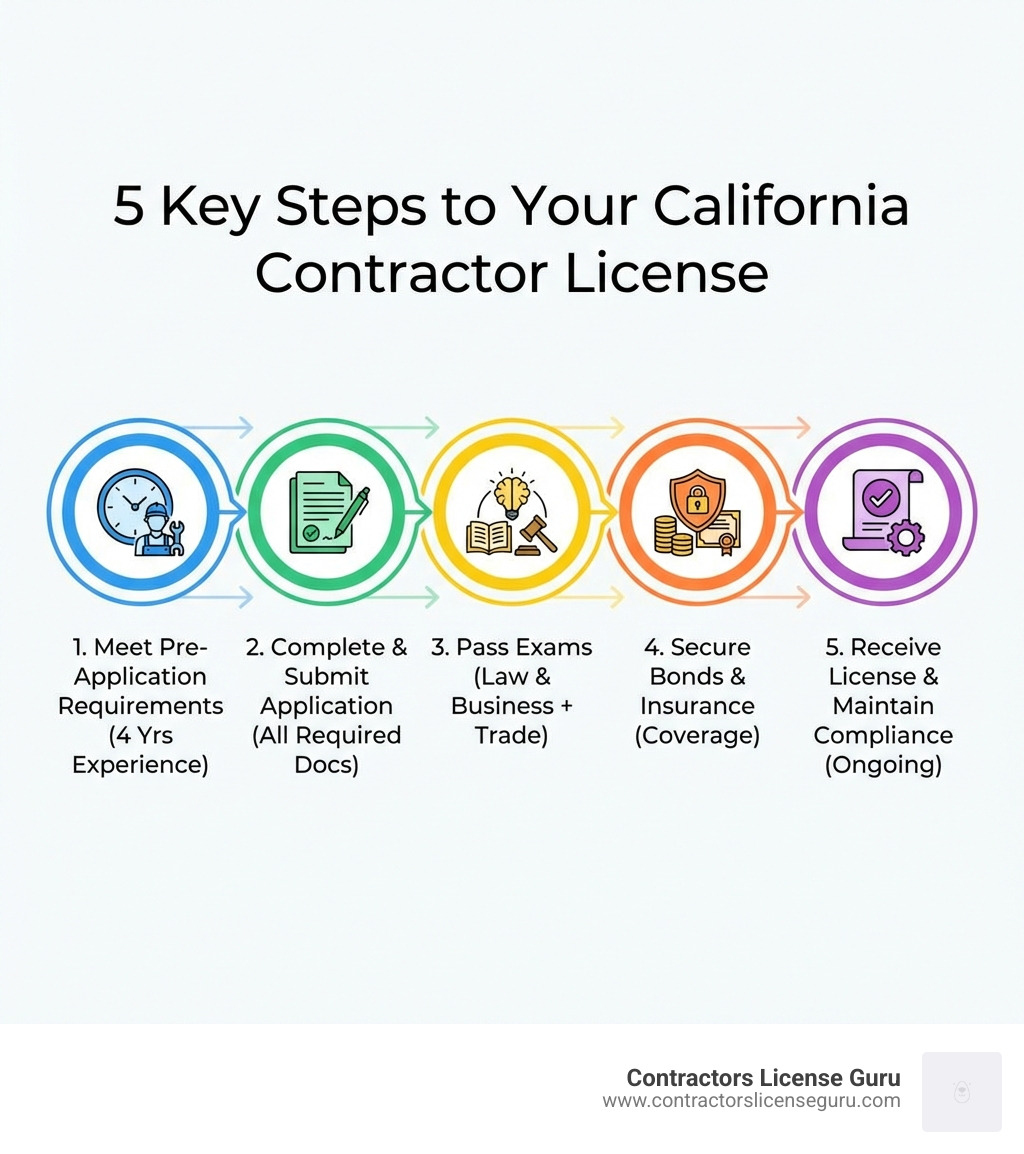
Before you even fill out a single form, understanding the foundational requirements for your contractor license application in California is crucial. This initial phase involves verifying your experience, understanding how education and training credits apply, and selecting the correct business structure and license classification for your operations.
In California, the CSLB requires that the qualifying individual for a contractor license have at least four (4) years of experience in the classification they are applying for, obtained within the last 10 years. This experience must be at no less than a journeyman level, or as a foreman, supervising employee, or another contractor. A “journeyman” is defined as an experienced worker who is fully qualified and able to perform the trade without supervision, or one who has completed an apprenticeship program.
Documenting this experience accurately is paramount. We use the “Certification of Work Experience” form, which must be completed by the qualifying individual and certified by a qualified and responsible person who has direct knowledge of the experience. The CSLB randomly reviews 3% of applications, and your experience must be verifiable through payroll records or similar documents.
For those claiming owner-builder experience for a B-General Building classification, a separate “Owner-Builder B-General Building Construction Project Experience” form is required for each project. This experience must be verifiable through building permits, final inspections, or similar documents.
Education and apprenticeship can also count towards your experience. The CSLB may grant up to three years of credit towards the four-year experience requirement for completed training in an accredited school and/or apprenticeship program in the construction trade. For formal education, official transcripts are needed, and for apprenticeship programs, a copy of your certificate.
Military service can also provide a significant advantage. If you are a current active-duty member or a veteran (not dishonorably discharged), you may be eligible for expedited processing and a 50% reduction in the initial license fee. Furthermore, the CSLB may grant credit towards licensure requirements for applicable work experience and training received during military service, provided it’s documented on a “Certification of Work Experience” form and supported by official military records.
While not a direct CSLB licensing requirement for California, it’s worth noting that other jurisdictions, like Philadelphia, require supervisors to show proof of an approved OSHA 30 safety training course within five years of the application date. This highlights the varying training demands across different states and cities.
To help you prepare for the examinations once your experience is approved, we offer comprehensive CSLB exam prep courses designed to equip you with the knowledge needed to pass.
Your chosen business structure impacts your contractor license application. In California, you can apply as a Sole Owner, Partnership, Corporation, Limited Liability Company (LLC), or Tribal Business. For corporations and LLCs, you must be registered and in good standing with the California Secretary of State.
Each license type requires a “qualifying individual” (QI), also known as a “qualifier.” This person meets the experience and examination requirements and is responsible for supervising and controlling the construction operations to ensure compliance with CSLB laws. The QI can be the owner, a partner, a Responsible Managing Officer (RMO), or a Responsible Managing Employee (RME). An RME must be a bona fide employee working at least 32 hours per week or 80% of the total hours per week the business is in operation, whichever is less.
Choosing the correct license classification is another critical step. The CSLB issues licenses in various classifications, generally categorized into:
You can only request one classification on an original application if an examination is required. For a complete description of the classifications and their specific scopes, the CSLB website provides a detailed list.

Once you’ve established your qualifications and chosen your classification, it’s time to tackle the actual contractor license application paperwork. This stage involves understanding the fees, gathering the necessary documents, and being aware of how criminal history might affect your application.
The application fee for a single classification in California is $450, and it’s non-refundable. After you successfully pass your examinations, a separate initial license fee is due: $200 for sole owners and $350 for non-sole owners. These fees are specific to California, and it’s interesting to see how they compare to other states:
Application processing times can vary significantly, ranging from several weeks to several months. Completeness of your application and the efficiency of background checks (especially if hard card fingerprints are used instead of live scan) can influence this timeline. If your application is not completed within one year of filing, or if it’s returned for correction and you don’t resubmit within 90 days, it may be deemed abandoned, leading to forfeiture of your application fees. We’ll show you how to avoid this.
You can check the status of your application online at www.cslb.ca.gov or by calling (800) 321-CSLB (2752) using the Application Fee Number and Personal Identification Number (PIN) provided in your acknowledgement letter. Always include your Application Fee Number in any correspondence with the CSLB.
Your contractor license application package will include several critical documents that must be completed accurately and thoroughly.

The primary document is the “Application for Original Contractor License.” This form is notorious for being returned due to inaccuracies or omissions, highlighting the importance of careful completion. You can find the official form here: Application For Original Contractors License -CSLB.
Another essential document is the “Certification of Work Experience” form, where you detail your four years of qualifying experience. This form must be filled out by the qualifying individual and certified by someone with direct knowledge of your work.
If you have a criminal history, you might be asked to submit a “Statement Regarding Criminal Plea/Conviction” form. This allows you to provide mitigating information for the CSLB’s review.
Finally, fingerprinting is a mandatory part of the process. After your application is accepted, you’ll receive instructions for obtaining and submitting fingerprints, usually via live scan electronic transmission. This allows the CSLB to conduct a criminal background check with the California Department of Justice and the FBI. Submitting hard card fingerprints can significantly delay the licensure process.
The CSLB takes criminal history seriously, and it’s crucial to be transparent. As part of your contractor license application, you must disclose all convictions, including DUIs and other Vehicle Code violations that resulted in a conviction. Even if you pled “no contest,” had the conviction set aside, or had the judgment deferred (commonly understood as “expunged”), the past conviction will still be reported to the CSLB.
The CSLB reviews each application individually; a criminal conviction does not automatically lead to denial. Their Criminal Background Unit (CBU) assesses factors such as the nature and severity of the crimes, the amount of time that has passed since the convictions, and any evidence of rehabilitation you submit. For rehabilitation evaluation, the CSLB generally looks at how much time has passed since the conviction without further violations of law. While providing mitigating evidence is voluntary, it can be beneficial. You can learn more about the CSLB’s criteria regarding convictions and rehabilitation on the Department of Consumer Affairs website: More on the CSLB’s criteria.
As an expert who has reviewed thousands of applications, we can tell you that nearly half of all applications are initially inaccurate or incomplete. Avoiding these common pitfalls can save you weeks or even months of delays.
Here are the top 5 application mistakes and how to prevent them:
By being diligent and meticulous in this stage, you significantly increase the chances of your contractor license application being processed smoothly.
Once your contractor license application is accepted and processed, the next phase involves demonstrating your knowledge through examinations and securing the necessary financial protections.
In California, the qualifying individual generally needs to pass two written examinations: the Law and Business Examination and a trade-specific examination for their chosen classification. These examinations are administered by an approved testing vendor, PSI Exams, and fees are paid directly to them.
To help you prepare, the CSLB offers official study guides for free on their website. We also provide comprehensive CSLB exam course overview and detailed study materials at Contractors License Guru to give you the best chance of success.
For applicants with disabilities, the CSLB provides reasonable accommodations under the Americans with Disabilities Act (ADA). You’ll need to complete a “Special Accommodation Request for Examination” form and submit supporting documentation.
There are specific circumstances under which examinations can be waived. If you currently serve, or within the past five years have served, as a qualifying individual for the same classification on a license in good standing, or have passed the law and trade examinations within the past five years, you may not be required to take the examination. Waiver provisions are outlined in California Business and Professions Code sections 7065.1 and 7065.2. If you meet the criteria for an examination waiver, you should use the “Application for Original Contractor License – Examination Waiver (7065)” instead of the standard application.
California also has reciprocity agreements with Arizona, Louisiana, Nevada, and North Carolina. If you are licensed in the same classification in one of these states, you may be eligible for a waiver of the trade examination, though the Law and Business Examination may still be required if not passed within the last five years.
If you are required to take an examination, you have 18 months after your application approval to achieve a passing score. If you fail an exam, you must wait 21 days before attempting it again, and you’ll pay a fee each time you reschedule.
Finally, all qualifiers must complete the Asbestos Open Book Examination as part of the licensure process. This is a separate requirement from any trade-specific asbestos certification.
Securing the appropriate bonds and insurance is a non-negotiable step in completing your contractor license application and maintaining your license. These protections safeguard the public and ensure financial responsibility.
The CSLB accepts cashier’s checks or bank-certified checks as alternatives to contractor bonds, but these cash alternatives must be retained by the CSLB for three years after the end of the last license period.
Obtaining your contractor license is a significant achievement, but it’s just the beginning. Maintaining and renewing your license, and understanding how to make necessary changes, are ongoing responsibilities.
Once all requirements are met—your application processed, exams passed, and bonds and insurance secured—your license will be issued. In California, contractor licenses are typically valid for two years. However, this varies by jurisdiction; for instance, a General Contractor registration in NYC is valid for three years.
Renewing your license is crucial to avoid lapses in your ability to legally operate.
Your business is dynamic, and your license needs to reflect those changes. The CSLB has specific forms and procedures for various modifications:
Staying on top of these administrative tasks ensures your license remains valid and compliant with all California regulations.
We often hear similar questions from contractors navigating the licensing process. Here are some of the most common ones:
The timeline for a contractor license application can vary significantly. Once your application is submitted, it undergoes an initial review. As noted, nearly half of all applications are returned for corrections, which can add weeks or months to the process.
Overall, from initial submission to license issuance, the process can range from a few months to over half a year, especially if there are delays due to incomplete information or background check complexities. Being thorough from the outset is your best strategy for a swift process.
If your contractor license application is rejected, it’s typically due to one of several reasons:
If your application is returned for correction, you generally have 90 days to provide the missing information or make the necessary changes and resubmit it. Failure to do so within this timeframe will result in your application being deemed abandoned, becoming void, and your application fee being forfeited. In such cases, you would need to submit a new application and pay the $450 application fee again.
Yes, it is possible to receive credit for experience gained outside of the U.S. when applying for your California contractor license. As a CSLB and overseas experience expert, Phil Cocciante has extensive knowledge in this area.
The key is to ensure that your foreign experience meets the CSLB’s criteria for journeyman-level or higher work in the classification you’re applying for, within the last 10 years. You will need to:
While it adds a layer of complexity, credit for overseas experience can certainly apply towards your four-year requirement. Our team specializes in helping you steer these unique circumstances.
Navigating the contractor license application process in California can seem daunting, but with a clear understanding of the requirements and a methodical approach, it’s a journey you can confidently complete. From carefully documenting your four years of journeyman-level experience and choosing the right classification to accurately completing your application, passing examinations, and securing essential bonds and insurance, each step is crucial.
Nearly half of all applications face delays due to inaccuracies or incompleteness. Being thorough and precise from the outset is your best defense against setbacks and forfeited fees.
That’s where professional guidance becomes invaluable. With over two decades of experience, including five years working directly within the CSLB, Phil Cocciante and the team at Contractors License Guru have the expertise to explain this complex process. We understand the nuances of CSLB regulations, the common pitfalls, and how to present a compelling and compliant application.
Don’t leave your contracting career to chance. Let us help you get your contractor license application right the first time.
