
Last updated: August 31st, 2026
An LLC contractor license in California requires specific steps beyond what sole proprietors face, including registration with the Secretary of State, additional bonding requirements, and mandatory liability insurance. Here’s what you need to know:
Key Requirements for LLC Contractor Licenses:
When Senate Bill 392 authorized the Contractors State License Board (CSLB) to issue licenses to limited liability companies, it opened new doors for contractors who wanted to operate through an LLC. But it also created unique requirements that differ significantly from sole proprietorships and corporations.
Nearly half of all CSLB applications are returned for being incomplete or inaccurate, causing delays of weeks or even months. For LLC applicants, the complexity increases because you’re managing both state business registration and contractor licensing simultaneously. Missing a requirement—like the $100,000 Employee/Worker Bond specific to LLC licenses—can halt your application.
The stakes are high. California generally requires a contractor license if the total cost of labor, materials, and all other project costs is $1,000 or more.
For California’s minor-work exemption to apply, all three conditions must be met:
A larger project also cannot be divided into smaller contracts in an attempt to qualify for the exemption.
I’m Phil Cocciante, and I’ve spent over 20 years helping contractors navigate CSLB requirements, including five years working directly at the Contractors State License Board as a license application technician. Since founding Contractors License Guru in 2005, I’ve guided thousands of contractors through the LLC contractor license process, helping ensure bonds, insurance policies, personnel records, and applications meet CSLB requirements.
This guide breaks down what you need to do to get your LLC licensed correctly.
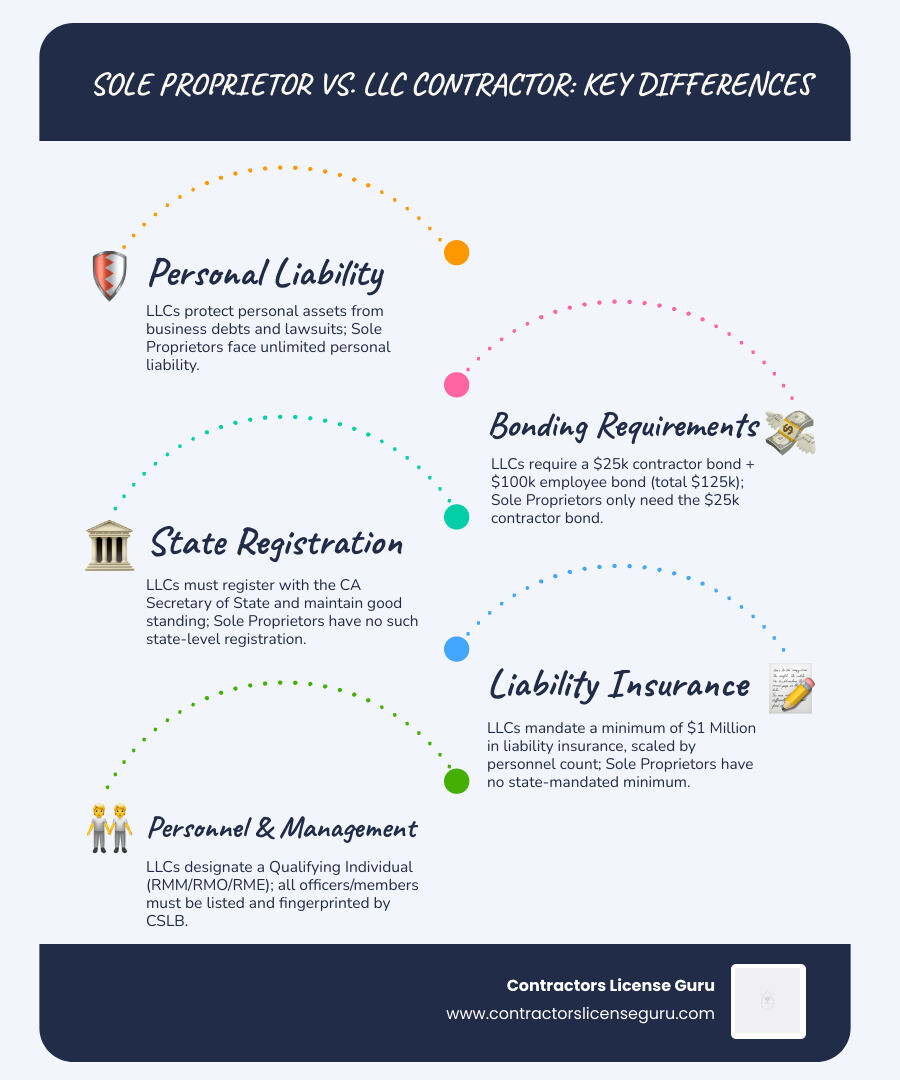
Establishing a Limited Liability Company (LLC) for your contracting business in California can offer significant advantages, particularly when it comes to separating the business entity from its owners.
While the process for obtaining an LLC contractor license can be more involved than licensing a sole proprietorship, an LLC may make sense depending on your liability concerns, tax situation, ownership structure, and business goals.

One reason many contractors consider an LLC structure is the limited liability protection it can provide.
An LLC is a separate legal entity from its owners. When properly formed and maintained, that separation can help protect members’ personal assets from certain business debts and liabilities.
If you operate as a sole proprietor, there is generally no separate legal entity between you and the business.
With an LLC, the separation between personal and business assets can reduce personal exposure in many circumstances. However, it’s crucial to maintain the entity properly. Mixing personal and business finances or otherwise disregarding the LLC structure can jeopardize those protections.
LLCs also offer flexibility in federal taxation. Depending on the number of members and any tax elections made, an LLC may receive pass-through tax treatment or elect another available tax classification.
You can learn more about related tax considerations in our article on S Corporations and Salaries.
When starting a contracting business, choosing the right legal structure is an important decision.
Here’s a basic comparison:
Choosing the right entity involves weighing liability, taxation, administrative requirements, licensing costs, ownership, and future growth.
For additional comparisons, see:
| Feature | Sole Proprietorship | Limited Liability Company (LLC) |
|---|---|---|
| Liability | No separate business entity | Separate legal entity with liability protections |
| Taxation | Generally reported by owner | Flexible federal tax treatment |
| CSLB Bonds | $25,000 Contractor’s Bond | $25,000 Contractor’s Bond + $100,000 LLC Employee/Worker Bond |
| CSLB Liability Insurance | Not generally required solely because of entity type | Minimum $1 million liability insurance mandatory |
| Personnel | Owner is primary personnel | Members, managers, and other applicable personnel must be reported |
| State Registration | No Secretary of State entity registration unless another structure is created | California Secretary of State registration and good standing required |
For more information about establishing your business entity, visit our Form a Corp or LLC resource.
Obtaining an LLC contractor license in California involves specific requirements established by the Contractors State License Board and California law.
LLC licenses have additional bonding and insurance obligations that do not apply in the same way to every other business entity.
Before your LLC contractor license can be issued, the Limited Liability Company must be registered with the California Secretary of State and in good standing.
Your California Secretary of State registration information must match the information submitted to CSLB.
If the LLC falls out of good standing or its registration becomes suspended or forfeited, it can affect the status of the contractor license.
When naming your LLC, the name must meet California Secretary of State requirements and be compatible with the business entity and CSLB classification being requested.
CSLB also has rules designed to prevent contractors from using business names that suggest they perform work outside the classifications on their licenses.
You can read more in our Contractors Business Name Style guide.
If you plan to operate under a name different from your legal LLC name, you may also need a fictitious business name. See Do I Need a DBA? for more information.
For California entity registration information, visit the California Secretary of State.
Every LLC contractor license must have a qualifying individual who meets the applicable experience and examination requirements and is responsible for exercising supervision and control over the LLC’s construction operations.
Depending on the company’s structure, the qualifying individual may serve in an appropriate capacity such as a:
The qualifying individual generally must document at least four years of qualifying journey-level or higher experience in the classification being requested within the applicable 10-year period.
“Journey-level” generally means the individual is fully qualified to perform the trade without supervision.
The experience must be certified by a qualified and responsible person with firsthand knowledge of the work performed, and CSLB can request supporting documentation to verify the experience claimed.
An RME must also satisfy CSLB’s employment and supervision requirements while serving as the qualifier.
Here’s where LLC contractor license requirements really differ from other business structures.
Like other active California contractor licenses, an LLC must maintain a $25,000 Contractor’s Bond with CSLB.
The contractor bond is filed for the benefit of consumers who may be damaged by defective construction or other violations of contractor license law and employees who haven’t received wages that are due to them.
The contractor license bond is not the same as a project-specific performance or completion bond.
You can review the CSLB Contractor Bond requirements for current information.
In addition to the Contractor’s Bond, an additional $25,000 Bond of Qualifying Individual may be required depending on the qualifying individual’s relationship to and ownership interest in the business.
For example, an RME generally requires a Bond of Qualifying Individual.
Certain qualifying individuals with at least the required ownership interest may qualify for an exemption from this additional bond.
This requirement is specific to contractor LLCs.
An active LLC contractor license must maintain an additional $100,000 LLC Employee/Worker Bond.
The bond benefits employees or workers who may be damaged by the LLC’s failure to pay:
This bond is in addition to the $25,000 Contractor’s Bond.
You can review CSLB’s current Licenses for Limited Liability Companies guidance for additional details.
California contractor LLCs are also required to maintain liability insurance.
For an LLC with five or fewer persons listed as personnel of record, the minimum aggregate limit is:
$1 million
For each additional person listed as personnel of record, the required coverage increases by $100,000, up to a maximum required amount of $5 million.
For example:
The insurance must satisfy CSLB’s requirements and remain in force while required for the license.
Workers’ compensation requirements are separate from the mandatory LLC liability-insurance requirement.
If your LLC has employees, including an RME, workers’ compensation insurance is generally required.
Certain contractor classifications are also required to maintain workers’ compensation coverage even if they have no employees.
Contractors with no employees who are not otherwise subject to mandatory workers’ compensation requirements may qualify to file the appropriate exemption with CSLB.
These requirements must be maintained as applicable to keep your LLC contractor license in good standing.
Getting your California LLC contractor license can feel like navigating a maze, but breaking the process into individual requirements makes it much easier.
The process begins with the appropriate contractor license application.
For an LLC, pay close attention to the following:
Make sure the company information you give CSLB matches the records maintained by the California Secretary of State.
Even relatively small discrepancies can create unnecessary delays.
For a typical examination application, the qualifying individual may be required to pass:
There are exceptions.
For example, C-61 Limited Specialty does not require a Trade examination, and examination waivers or exemptions may apply when an applicant satisfies the applicable statutory requirements.
Prior examination history, prior service as a qualifier, reciprocity, and other circumstances can affect which examinations are required.
Make sure you know your actual examination requirements before purchasing preparation materials or scheduling tests.
After the examination requirements have been completed—or waived when applicable—CSLB will notify you of the remaining items needed before the LLC contractor license can be issued.
For an LLC, these can include:
Once CSLB verifies that the applicable requirements have been satisfied, the LLC contractor license can be issued.
Obtaining an LLC contractor license is only the first part of the process.
Your LLC must continue complying with both CSLB and California Secretary of State requirements while operating.
An active California contractor license generally renews every two years.
Important ongoing requirements for an LLC include:
Failure to maintain required bonds or insurance can result in suspension of the contractor license.
A contractor license is issued to a particular licensing entity and is generally not freely transferable from one entity to another.
LLC ownership, personnel, qualifier, or organizational changes can create CSLB reporting requirements.
Depending on the circumstances, you may need to:
If your company changes its legal name or begins operating under a different business name, review CSLB’s business-name requirements before making the change.
California contractor licenses are divided into several categories and numerous individual classifications.
The classification on your LLC contractor license determines the scope of contracting work the LLC is authorized to perform.
The major categories include:
Examples include:
Choosing the right classification depends on the type of work the LLC intends to contract for.
Review our California Contractors License Classifications resources when determining which classification best matches your scope.
The Contractors State License Board should always be your primary source for current forms, licensing requirements, and regulations.
You can also:
For LLC applicants, there are more moving pieces than with many other entity types.
You have to coordinate:
If you need help navigating the process, contact Contractors License Guru for guidance.
Obtaining an LLC contractor license in California involves additional requirements beyond simply forming an LLC with the Secretary of State.
For contractor LLCs, three of the most important financial requirements to remember are:
Depending on the qualifier, an additional $25,000 Bond of Qualifying Individual may also be required.
And remember that California’s minor-work exemption isn’t simply a “$1,000 rule.”
For the exemption to apply, the total project cost must be less than $1,000, the project must not require a building permit, and no employee labor may be used.
Getting the entity, classification, qualifier, bonds, insurance, and application details right from the beginning can prevent costly licensing delays.
At Contractors License Guru, we help California contractors navigate those requirements and prepare their applications properly.
Ready to move forward? Learn more about forming a corporation or LLC or contact us for help with your contractor licensing process.