
Last updated: August 31st, 2026
California LLC tax requirements can catch even experienced contractors off guard. Here’s what California LLCs may be required to pay or file, depending on their tax classification and income:
Some California LLC requirements apply even when the LLC has little or no income, including the $800 annual tax in most cases. However, the income-based LLC fee applies only when total California income reaches $250,000, and filing requirements and deadlines can vary depending on the LLC’s tax classification.
As a licensed contractor, you’ve got enough on your plate with high-pressure deadlines and managing jobs. The last thing you need is an unexpected tax bill or penalty from the Franchise Tax Board because you missed a filing deadline or underestimated your LLC fee.
The stakes are even higher for contractors. Beyond standard California LLC tax requirements, contractors face additional obligations. If you structure your business as an LLC, the Contractors State License Board (CSLB) requires a $100,000 surety bond specifically for employee wages and benefits, plus liability insurance starting at $1,000,000. Nearly half of all CSLB applications are returned for being inaccurate or incomplete, and tax-related oversights can derail your licensing process entirely.
I’m Phil Cocciante, and after five years as a license application technician at the CSLB and over 20 years in the construction industry, I’ve seen countless contractors struggle with California LLC tax requirements during the licensing process. My experience helping thousands of contractors navigate both CSLB regulations and business entity compliance has taught me exactly where contractors get tripped up and how to avoid those costly mistakes.
In California, the $800 annual tax is essentially a “subscription fee” for the privilege of doing business in the state. Every LLC that is organized in California, or merely registered to do business here, must pay this tax. This applies even if you haven’t booked a single job or if your tools are gathering dust in the garage.
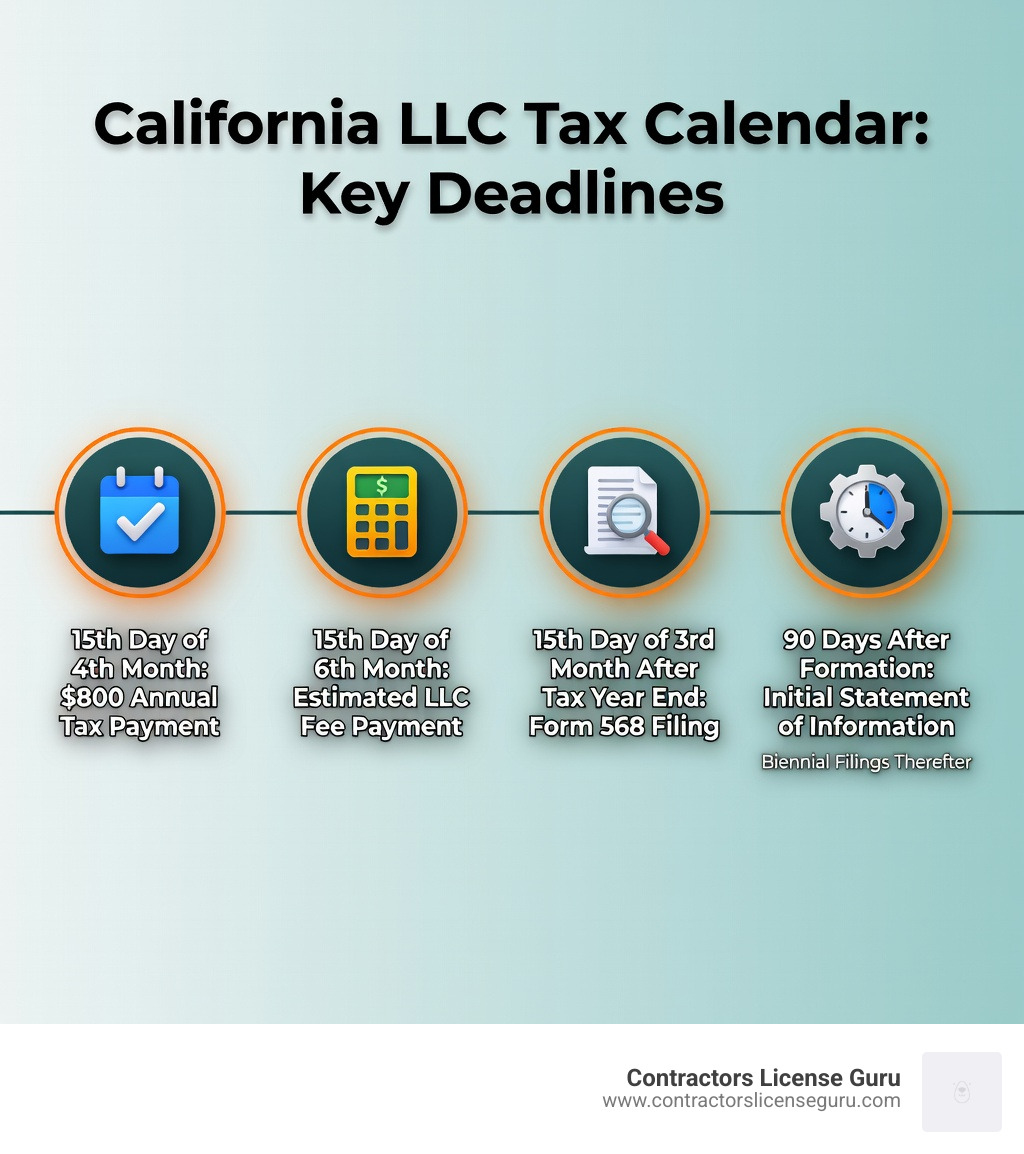
The payment is made using LLC Tax Voucher (FTB 3522). For existing LLCs, this tax is due by the 15th day of the 4th month of your taxable year. If you operate on a standard calendar year, that date is April 15th. It is important to note that this tax is not deductible for California state tax purposes.

While the $800 tax is a standard burden, there are a few scenarios where you might catch a break.
Once your gross receipts start climbing, the state wants a bigger slice of the pie. This is where the “LLC Fee” comes in. Unlike the flat $800 tax, this fee is graduated based on your total California income.
Total California income includes your gross income plus the cost of goods sold from California sources. You must estimate this fee and pay it by the 15th day of the 6th month of the current tax year using Form 3536.
| Total California Income | LLC Fee |
|---|---|
| $0 – $249,999 | $0 |
| $250,000 – $499,999 | $900 |
| $500,000 – $999,999 | $2,500 |
| $1,000,000 – $4,999,999 | $6,000 |
| $5,000,000 or more | $11,790 |
Failure to pay this estimated fee on time can result in a 10% underpayment penalty. For more details on these brackets, you can visit the California DTFA: Limited Liability Company page.
A Single-Member LLC (SMLLC) is often treated as a “disregarded entity” for federal tax purposes, meaning the income is reported on the owner’s personal Schedule C. However, California still requires SMLLCs to follow California LLC tax requirements.
Even if you are a one-man show, you must still pay the $800 annual tax and the graduated LLC fee if your income exceeds $250,000. You will still use Form 568 to report your income and calculate what is owed. If you’re wondering if this structure is right for your contracting business, check out our guide on Should I Form a Limited Liability Company? or compare your options in Corp vs LLC.
Form 568, the Limited Liability Company Return of Income, is the master document for your LLC’s tax reporting. If your LLC is classified as a partnership, this form is generally due by the 15th day of the 3rd month after the close of your taxable year (March 15th for calendar year filers).
While California grants an automatic seven-month extension to file the return, this does not extend the time to pay. Any taxes or fees owed must be paid by the original due date to avoid interest and penalties. You can find the full Instructions to Limited Liability Company Return of Income on the FTB website.
If your LLC has members who live outside of California, things get a bit more technical. California requires every nonresident member to sign Form 3832, Limited Liability Company Nonresident Member’s Consent. By signing this, the member agrees to pay California taxes on their distributive share of the LLC’s income.
If a nonresident member refuses to sign, the LLC itself becomes responsible for paying the tax on that member’s share at the highest marginal rate. This is a critical step in Nonresident Withholding Partnership Guidelines that can lead to unexpected out-of-pocket costs for the company if not handled correctly.
For those of us in the trades, an LLC isn’t just about taxes; it’s about licensing. The CSLB has very specific (and expensive) rules for LLCs that don’t apply to sole proprietors or standard corporations.
To maintain an active contractor license as an LLC, you must:
Choosing the right structure is vital for your bottom line. We often suggest contractors look at Comparing Corporations to Sole Proprietorships to see if the added costs of an LLC are truly worth the liability protection in their specific case.
The state of California is very efficient at collecting penalties. One of the most common traps is the Statement of Information. You must file this with the Secretary of State within 90 days of formation and then every two years (biennially) thereafter.
The filing fee is only $20, but if you forget, the Secretary of State will impose a $250 penalty, which is then collected by the Franchise Tax Board. You can file this online through the Statement of Information with the SOS portal.
Additionally, you must maintain a registered agent with a physical California address and keep an internal operating agreement. While you don’t file the operating agreement with the state, California law mandates that every LLC has one.
Late payments are a slippery slope. If you underpay your estimated LLC fee, the FTB hits you with a 10% penalty on the amount owed. If you file Form 568 late, the penalty is $18 per member, per month, for up to 12 months.
To stay on top of payments, many contractors use the officialpayments.com Credit Card service or the FTB Web Pay system. Even if you have an extension to file, the money must be in the state’s hands by the original deadline to stop the interest clock from ticking.
At a minimum, you are looking at:
The estimated LLC fee is due by the 15th day of the 6th month of your tax year. For most, this is June 15th. You use Form 3536 to make this payment. This is separate from the $800 annual tax due in April.
Yes. As long as your LLC is “organized” in California or “doing business” (which has a very broad definition including simply having a California-based manager), the $800 tax is mandatory. The only way to stop this requirement is to formally dissolve the entity using a Short form cancellation (SOS Form LLC-4/8) or a formal dissolution process.
Managing California LLC tax requirements is a full-time job in itself. For contractors, the complexity is doubled by CSLB bonding and insurance mandates. Missing a single deadline or failing to file a biennial report can lead to suspended licenses, hefty fines, and lost work.
At The License Guru, we specialize in making this process as painless as possible. Whether you are just starting out and need help choosing the right entity, or you’re an established contractor looking to transition to an LLC without the CSLB rejecting your application, we are here to help. We offer expert application services, study guides, and the insider knowledge that only comes from years of working within the CSLB.
Don’t let paperwork stand between you and your next big project. Get expert help with your California LLC and Contractor License today and ensure your business stays compliant and protected.