
A home improvement contractor license check is how you confirm a contractor is legally allowed to work on your home. Here’s how to do it fast:
Quick ways to check a contractor’s license:
You’ll need the contractor’s license number, business name, or last name to search. All checks are free.
Hiring the wrong contractor can cost you thousands. An unlicensed contractor offers no legal protections, no access to consumer guarantee funds, and no recourse if work goes wrong. In Massachusetts alone, registered contractors give homeowners access to a Guaranty Fund that can pay out up to $25,000 for unpaid judgments. In California, licensed contractors are required to carry a $25,000 bond. These protections disappear the moment you hire someone who isn’t properly licensed.
I’m Phil Cocciante, and after five years working as a license application technician at the CSLB and over 20 years in the construction industry, I know exactly what a home improvement contractor license check reveals – and what it misses. In this guide, I’ll walk you through every step so you can hire with confidence.
When we talk about a “home improvement contractor,” we aren’t just talking about someone painting a fence. In many states, this is a specific legal designation. For example, in Massachusetts, the law requires anyone working on an existing 1-to-4-unit, owner-occupied primary residence to be registered as a Home Improvement Contractor (HIC).
Why does this matter to you? Because the state uses these registrations to create a safety net. If you perform a home improvement contractor license check and hire a registered pro, you gain access to the Guaranty Fund protection. This fund can compensate homeowners up to $25,000 for unpaid judgments against registered contractors. If you hire an unlicensed worker to save a few bucks, you are effectively throwing that $25,000 insurance policy in the trash.
In California, the Contractors State License Board (CSLB) oversees all licensing. If a worker gets injured on your property and the contractor doesn’t have workers’ compensation insurance—which is a requirement for a valid license if they have employees—you could be held financially liable for those injuries.
Understanding the California Contractors State License Board (CSLB) is the first step in realizing that a license isn’t just a piece of paper; it’s a verification of experience, a background check, and a commitment to state safety standards.
Hiring an unlicensed contractor is like skydiving with a backpack full of silverware instead of a parachute. It might feel lighter at first, but the landing is going to be painful. Unlicensed contractors often fly under the radar because they cannot get permits, which means your home improvement project might not meet building codes. This can lead to massive headaches when you try to sell your home later.
| Feature | Licensed/Registered Contractor | Unlicensed Contractor |
|---|---|---|
| State Oversight | Regulated by CSLB, HIC, or DLLR | None |
| Bonding | $25,000 Bond (CA) | None |
| Consumer Funds | Access to Guaranty Fund (MA) | None |
| Legal Recourse | State-mediated complaint process | Civil lawsuit only (expensive) |
| Insurance | Verified Workers’ Comp & Liability | Likely none |
| Permits | Can legally pull building permits | Often asks homeowner to pull permits |

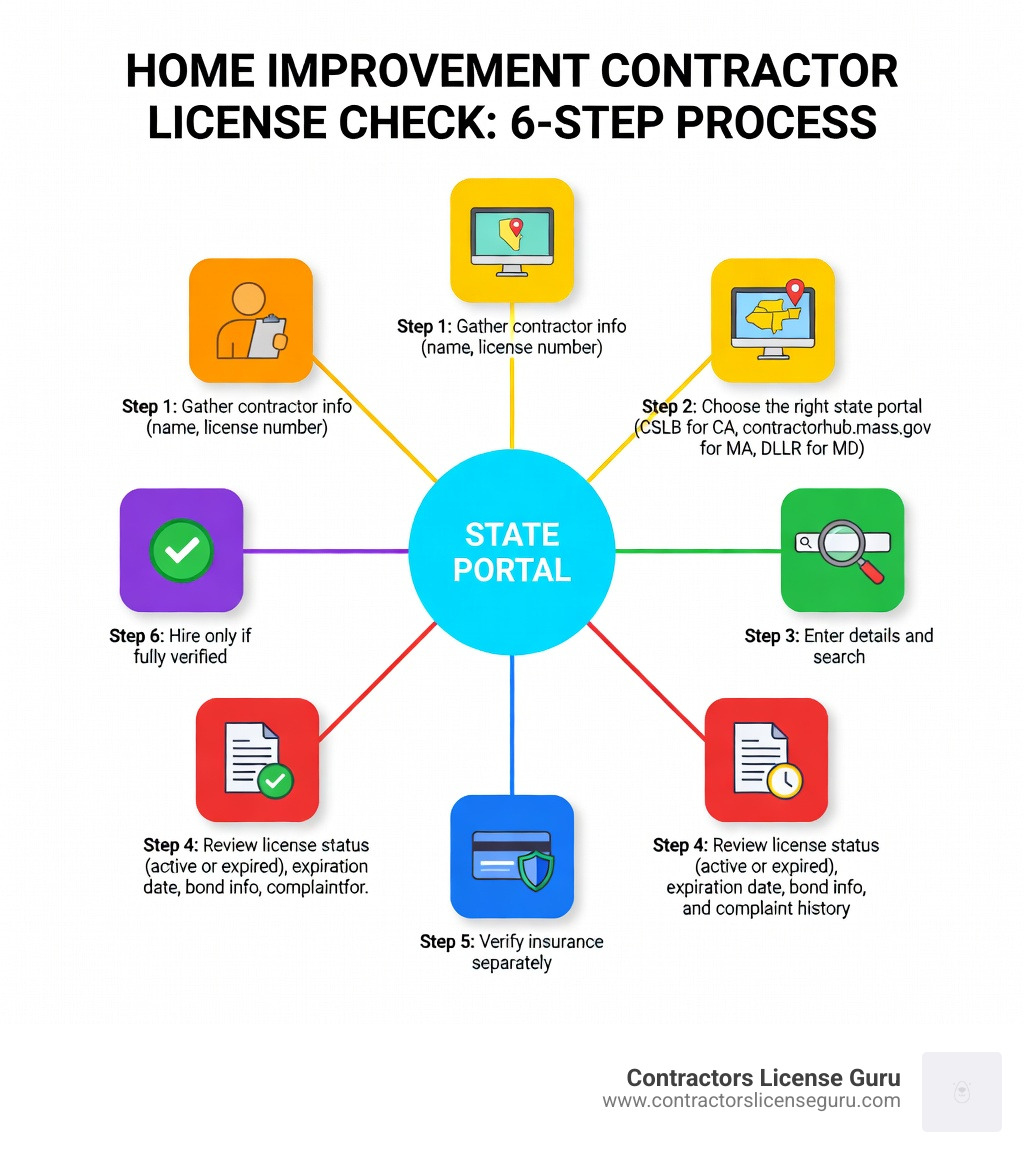
Performing a home improvement contractor license check is surprisingly easy once you know where to look. Most states have moved these databases online, making them accessible 24/7.
To start your search, you generally need one of three things:
We always recommend asking the contractor for their license number directly. In states like Oregon and California, contractors are legally required to put their license number on all advertising, including business cards and truck decals. If they hesitate to give it to you, that’s your first red flag.
California has some of the strictest and most transparent licensing laws in the country. The CSLB website is a goldmine of information if you know how to read it.
Always check the expiration date. A license that was active yesterday but expired today is a legal liability.
A license is the foundation, but it isn’t the whole house. To truly protect yourself, your home improvement contractor license check must include a look at their insurance and bonds.
In California, if a contractor has even one employee, they must carry workers’ compensation insurance. You can verify this directly on the CSLB license detail page. If they claim they have no employees, they must file an exemption. However, certain classifications (like C-39 Roofing) must carry workers’ comp even if they work alone because the job is so high-risk.
For general liability insurance, we recommend asking the contractor for a “Certificate of Insurance” (COI) that names you as the “certificate holder.” You can also cross-reference with the California Department of Insurance if you need to verify a specific carrier.
Licensed California contractors must have a $25,000 contractor license bond. This isn’t a “satisfaction guarantee” for you; it’s a bond that ensures the contractor follows the law. If they abandon your project or fail to pay their workers, you (or the workers) can make a claim against that bond.
To dig deeper into how these work, check out our article Decoding the Bonded and Insured Contractor Conundrum.
Did a smooth-talking salesperson knock on your door to sell you solar or a kitchen remodel? In California, that person must be registered as a CSLB Home Improvement Salesperson (HIS). Ask to see their HIS registration card and their photo ID. If they aren’t registered, they aren’t legally allowed to sign a contract with you on behalf of the contractor.
Even if the home improvement contractor license check comes back clean, you need to watch how the contractor handles money. State laws are very specific about how much a contractor can take upfront.
In California, the law is crystal clear: a contractor cannot ask for a down payment of more than 10% of the total contract price or $1,000, whichever is less.
If a contractor asks for $5,000 upfront for a $20,000 kitchen remodel, they are breaking the law. The only exception is if the contractor has a “Blanket Performance and Payment Bond” on file with the CSLB, but only about two dozen contractors in the entire state have one of those. You can find more details on these requirements in our guide to CSLB Home Improvement Contract Requirements.
After the down payment, any further payments should be “progress payments.” This means you only pay for work that has actually been completed or materials that have been delivered to your home. If the contractor asks for more money because “lumber prices went up” or they “need to pay their crew,” but no work has been done, keep your checkbook closed.
If you encounter an unlicensed contractor or someone violating these payment rules, don’t just walk away—report them. You can Report Unlicensed Activity to the CSLB to help protect your neighbors.
Also, keep an eye on the Better Business Bureau (BBB) for customer reviews. While the BBB isn’t a government agency, it’s a great way to see how a contractor handles disputes. Note: The Contractors License Guru does not support the BBB or condone its membership tactics.
If your home improvement contractor license check shows the contractor is unlicensed, do not hire them. It is illegal for them to perform work over $1000 in California or work on 1-4 unit owner-occupied homes in Massachusetts. You should politely decline their bid and find a licensed professional. You can also report them to the state licensing board to prevent them from scamming others.
We recommend getting at least three written bids. Make sure all three contractors are bidding on the exact same set of plans and specifications. If one bid is significantly lower than the others, it’s usually because they are cutting corners, using inferior materials, or—you guessed it—aren’t paying for proper insurance and licensing.
A home improvement contractor license check is the single most important thing you can do before starting a renovation. It takes five minutes and can save you five years of legal and financial misery. By verifying the license, checking for bonds and insurance, and following state payment rules, you put yourself in the driver’s seat of your project.
At Contractors License Guru, we’ve helped thousands of people navigate the complexities of the CSLB. Whether you are a homeowner looking for peace of mind or an aspiring contractor looking to get licensed the right way, we are here to provide professional guidance.
Before you sign that contract, take one last look at our California Contractor License Check: How to Verify a Contractor’s Credentials to ensure you haven’t missed a single detail. Happy building!