
A California B General Building Contractor License is one of the most common contractor license classifications in the state. It’s also one of the most misunderstood. Many people assume a general building license automatically allows a contractor to take almost any construction job. The B license is broad, but it does not give unlimited authority to perform every standalone specialty trade.
Before bidding, contracting, self-performing work, or subcontracting part of a project, a B contractor needs to understand what the license covers, when the two-unrelated-trades rule applies, and when a specialty classification may be required.
The CSLB defines a B General Building Contractor as a contractor whose principal contracting business is connected with structures built, being built, or to be built for the support, shelter, and enclosure of people, animals, chattels, or movable property, when the construction requires at least two unrelated building trades or crafts. (CSLB)
In simpler terms, a B General Building contractor generally works on building projects that involve multiple unrelated trades.
Common examples may include:
A B contractor may also superintend, or oversee, all or part of a qualifying building project.
The important word is qualifying. Not every construction task automatically falls under the B license.
One of the most important rules for B General Building contractors is the two-unrelated-trades rule.
Under CSLB’s B classification language, a general building contractor may take a prime contract or subcontract for a framing or carpentry project. However, for projects involving trades other than framing or carpentry, the project generally must require at least two unrelated building trades or crafts, unless the B contractor holds the proper specialty classification or subcontracts with an appropriately licensed specialty contractor. (CSLB)
Framing and carpentry also cannot be counted as one of the two unrelated trades needed for a B contractor to take a project involving other trades. (CSLB)
For example, a qualifying B project may include:
The point is not simply that the project is “construction.” The point is whether the project fits within the scope of the B classification.
A B license does not automatically authorize a contractor to self-perform every standalone specialty trade.
For example:
That does not mean a B contractor can never contract for work involving those trades. The answer depends on the project scope, whether the B contractor is acting as the prime contractor or a subcontractor, and whether the contractor will self-perform the work or subcontract it to a properly licensed specialty contractor.
For example, a B contractor may be able to take a broader remodel that includes electrical, plumbing, drywall, and finish work as part of one qualifying multi-trade project. But standalone self-performed electrical work is a different issue and generally requires the proper electrical classification.
The distinction between a prime contract and a subcontract is critical.
A prime contract is a contract directly with the owner of the property. A subcontract is when the B contractor does not have a direct contractual relationship with the owner and is instead hired by another contractor.
The CSLB’s Building Official Information Guide explains that a B contractor may take a prime contract for a single specialty project if the B contractor holds the specialty classification or subcontracts the work to an appropriately licensed specialty contractor. (CSLB)
However, the CSLB also explains that a B contractor generally cannot take a single-trade subcontract, excluding framing or carpentry, unless the B contractor holds the required specialty license classification. (CSLB)
Here is the practical difference:
This is where many contractors get confused. The same type of work may be treated differently depending on whether the B contractor is the prime contractor or a subcontractor.
A B contractor may perform electrical work when it is part of a qualifying B General Building project that involves the required scope of work. However, standalone electrical work generally requires a C-10 Electrical Contractor License if the contractor intends to self-perform that work.
For example, if a B contractor is remodeling a kitchen and the project includes plumbing, electrical, cabinetry, drywall, and finishes, the electrical portion may be part of the larger qualifying B project.
But if the job is only to replace, install, or modify an electrical system as a standalone project, that is generally C-10 work.
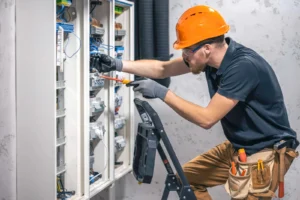
The same general principle applies to plumbing. A B contractor may perform plumbing work when it is part of a qualifying B General Building project. For example, a bathroom remodel involving plumbing, electrical, tile, drywall, and finish work may fit within the B classification.
However, standalone plumbing work generally requires a C-36 Plumbing Contractor License if the contractor intends to self-perform that work.
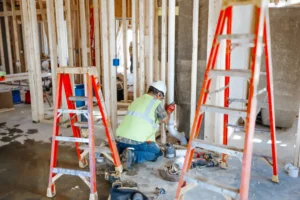
Roofing is one of the most common scope-of-work questions for B contractors.
According to the CSLB’s B General Building Fast Facts sheet, a B General Building contractor may contract for projects that include roofing. However, if the roofing is a standalone contract and is not included in a larger project involving two or more unrelated trades, the B contractor must subcontract the roofing to a C-39 Roofing Contractor unless the B contractor also holds the C-39 classification. (CSLB)
In other words, roofing may be allowed as part of a larger qualifying B project, such as home construction, a room addition, or a remodel involving multiple unrelated trades. But standalone roofing has stricter limits.
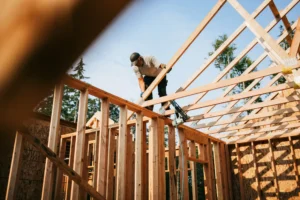
A B contractor may perform concrete work when it is part of a qualifying B General Building project.
For example, concrete may be part of a room addition, foundation work, structural building work, or a broader remodel involving multiple unrelated trades. However, standalone concrete work may require the proper specialty classification, such as a C-8 Concrete Contractor License, if the contractor intends to self-perform that work.
A B contractor may perform HVAC-related work when it is part of a qualifying B General Building project involving the necessary scope of work.
However, standalone HVAC work generally requires the appropriate specialty classification, such as a C-20 Warm-Air Heating, Ventilating and Air-Conditioning Contractor License, if the contractor intends to self-perform that work.
The B classification includes specific limits for projects involving the C-16 Fire Protection classification or the C-57 Well Drilling classification.
A B contractor cannot contract for a project that includes C-16 fire protection or C-57 well drilling work unless the B contractor holds the specialty license or subcontracts with an appropriately licensed specialty contractor. (CSLB)
Because these areas have specific classification rules, contractors should be careful before assuming the work falls under a general building license.
The B General Building exam is designed to test knowledge related to general building work.
According to the CSLB’s official B General Building Study Guide, the exam is divided into five major sections:
The Core Trades section is the largest portion of the exam and includes subjects such as plumbing, electrical, HVAC, concrete, earthwork and surveying, insulation, weatherproofing, and roofing. (CSLB)
Applicants preparing for the B General Building exam should also remember that most applicants must prepare for both the B trade exam and the Law and Business exam.
Contractors License Guru offers B General Building exam preparation and a Law and Business Contractors Exam Study Kit for California contractor license applicants.
No. The CSLB states that framing and carpentry cannot be counted as one of the two unrelated trades required for a B contractor to take a project involving other trades. (CSLB)
The B General Building exam includes Planning and Estimating, Framing and Structural Components, Core Trades, Finish Trades, and Safety. Core Trades is the largest section at approximately 30% of the exam. (CSLB)
Most California contractor license applicants must prepare for the trade exam and the Law and Business exam unless they qualify for a waiver.