
What You Need to Know Before Starting Your General B License Application
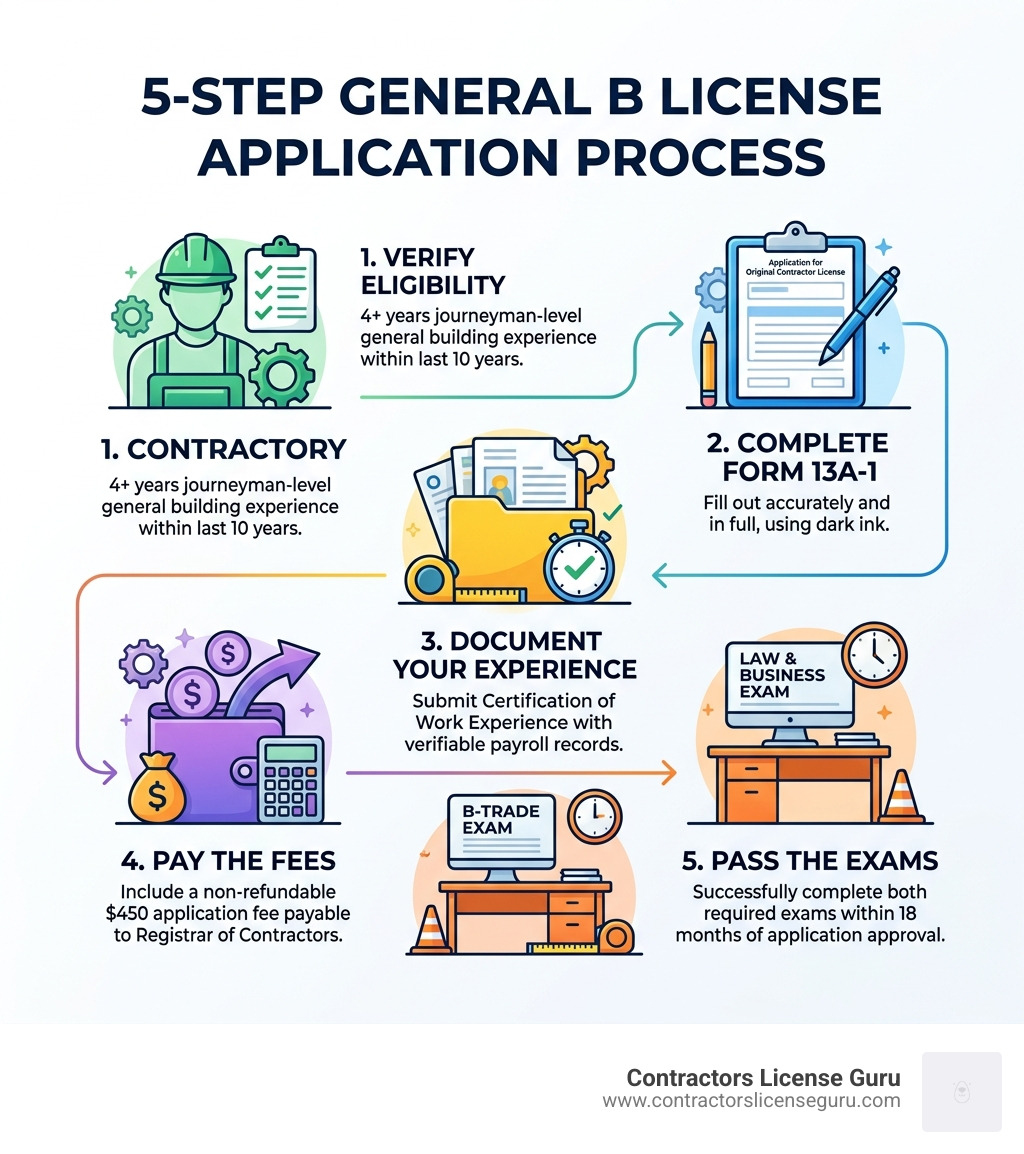
A General B license application is the official process through which contractors in California apply to the Contractors State License Board (CSLB) for a B-General Building contractor license. Here is a quick overview of the five core steps:
- Verify eligibility – Confirm you have at least 4 years of journeyman-level experience in general building construction within the last 10 years.
- Complete Form 13A-1 – Fill out the Application for Original Contractor License accurately and in full, in black or dark blue ink.
- Document your experience – Submit Certification of Work Experience forms with verifiable payroll records from qualified certifiers.
- Pay the fees – Include a non-refundable $450 application fee payable to the Registrar of Contractors.
- Pass the exams – Pass the Law and Business exam and the B-Trade exam through PSI testing centers within 18 months of application approval.
Getting this right matters. Nearly half of all CSLB applications are returned because they are inaccurate or incomplete — a costly delay that can set your timeline back by weeks or months.
The process has real complexity. From documenting the right type of experience to answering disclosure questions correctly, there are many places where a small mistake can stall your license. This guide walks you through every stage so you can move forward with confidence.
I’m Phil Cocciante, also known as The License Guru — and after five years working as a license application technician directly at the CSLB, I’ve spent the last two decades helping contractors navigate the exact General B license application process outlined in this guide. If you’d rather have an expert handle it for you, Contractors License Guru is here to help at every step.
Mastering the General B License Application Process
The journey to becoming a licensed general building contractor in California begins at the CSLB headquarters in Sacramento. But before we dive into the paperwork, we need to define exactly what this license allows you to do.
In California, a B-General Building contractor is a “prime contractor” whose principal business involves projects that require the use of at least two unrelated building trades or crafts. However, there is a major caveat: the work must include framing or carpentry unless you are subcontracting those specific portions to a licensed specialist.
To successfully navigate the General B license application, you must demonstrate that you have the qualifying B General Contractors Experience necessary to manage these multi-trade projects. This isn’t just about swinging a hammer; it’s about supervision, technical knowledge, and the ability to oversee a project from start to finish. If you are looking for a bird’s-eye view of the entire journey, check out our How to Get a General Building License in California Step by Step Guide.
Eligibility for the General B License Application
Who is eligible to apply? The CSLB is very specific. The “qualifying individual” (the person whose experience will be used to get the license) must have at least four years of experience within the last ten years at a journeyman level or higher.
What does “journeyman level” mean? We define it as a person who has completed an apprenticeship program or is a fully qualified worker who can perform the trade without supervision. You can also qualify if you have served as a foreman, supervising employee, or even as an owner-builder. If you are aiming for becoming a Residential General Contractor in California, those four years must be verifiable and fall within the decade immediately preceding your application date.
Who Needs a General B License?
If you plan to take on projects that exceed $500 in total labor and material costs, you need a license. For the General B classification, your project scope usually involves structural work or multiple trades.
We often get asked about the “two-trade rule.” Essentially, if you are performing a job that only involves one trade (like just painting or just flooring), you should technically have a C-specialty license. The General B is designed for those who act as the “prime,” coordinating various aspects of a build.
Documenting Your 4-Year Journeyman Experience
The single most important part of your General B license application is the Certification of Work Experience. This is where most applicants stumble. You need a “certifier”—someone with direct knowledge of your work—to sign off on your hours. This could be a former employer, a fellow journeyman, or even a client if you were working as an owner-builder.
When describing your general building experience, don’t be vague. We recommend using specific industry terms. Instead of saying “I built houses,” say “I performed structural framing, rough plumbing, and electrical installations for new residential construction.” The CSLB wants to see that you have handled the “prime” responsibilities. For a deeper dive into how the board views these descriptions, read how the CSLB Explains B General Experience.
Owner-Builder and Education Credits
Not all four years have to be spent on a payroll. We can often help you use education or apprenticeship credits to shave time off the requirement. You can receive up to three years of credit for a Bachelor of Science in a related field or a completed apprenticeship.
| Experience Type | Maximum Credit Allowed |
|---|---|
| Journeyman Field Experience | 4 Years (Full Requirement) |
| B.S. in Construction Management | 3 Years |
| Associate Degree in Construction | 1.5 to 2 Years |
| Completed Apprenticeship | 3 Years |
If you are using owner-builder projects, you must submit the “Owner-Builder B-General Building Construction Project Experience” form for each project. You will also need to provide building permits to prove the work was legal and inspected. To view these forms, make sure you have the latest software; here is a link for How to get the Acrobat Reader.
The 3% Random Audit Risk
We want to warn you: the CSLB is required by law to randomly audit 3% of all applications. This means they will dig deep into your claimed experience. They may ask for tax returns, W-2s, or verifiable payroll records.
If you are applying for a B General Contractors License, honesty is the only policy. If the board finds that you’ve misrepresented your experience, they can deny your application and bar you from applying again for several years. We ensure our clients have the documentation ready before they hit “submit.”
Step-by-Step Guide to Completing Form 13A-1
The “Application for Original Contractor License” (Form 13A-1) is the backbone of your submission. You’ll need to decide on your business entity first. Are you a sole owner, a partnership, a corporation, or an LLC? Each has different bonding and insurance requirements.
Our General Contractor License Ultimate Guide breaks down these entities in detail, but your business name must be compatible with your classification. For example, “ABC Plumbing” would not be an acceptable name for a General B license, but “ABC Construction” would be.
Avoiding Delays in Your General B License Application
As we mentioned, the CSLB returns nearly 50% of applications. Why? Usually, it’s something simple like a missing signature or an empty box. We tell our clients to write “N/A” in boxes that don’t apply rather than leaving them blank.
Section 5 of the application is where you disclose judgments, liens, and criminal history. If you have to answer “Yes” to any of these, don’t panic—but do be thorough. You may need to provide a Criminal Conviction Application Worksheet or court documents. A conviction doesn’t automatically disqualify you; the CSLB considers “rehabilitation” and the time passed since the incident. However, failing to disclose a conviction is almost a guaranteed rejection.
Special Provisions and Expedited Processing
There are ways to move to the front of the line. If you are an active-duty military member, a veteran, or a spouse of one, you may qualify for expedited Licensure Application processing for service members. Programs like Skillbridge can also help veterans transition into the trades faster.
California also offers reciprocity with certain states like Arizona, Nevada, and Louisiana. If you have held a valid license in one of those states for at least five years, you might be able to waive the trade exam. Additionally, if you’ve had a legal name change, you’ll need to submit a Name and Gender Change Notification to keep your records straight.
Passing the CSLB Law and Trade Examinations
Once the CSLB approves your General B license application, they will send you a “Notice to Appear for Examination.” You have 18 months to pass two tests:
- Law and Business: Covers contracts, labor law, safety (Cal/OSHA), and bookkeeping.
- B-Trade Exam: Covers framing, concrete, roofing, and project management.
You will take these exams at a PSI testing center. If you fail, you have to wait 21 days to try again. We highly recommend taking a CSLB Exam Preparation Course to ensure you pass on the first attempt. The trade exam is notoriously difficult because it covers such a wide variety of construction topics.
Study Strategies and Exam Waivers
Don’t just memorize questions; understand the “why” behind the answers. Our Contractors License Exam Course Overview shows you exactly what to focus on.
In some cases, you might qualify for an exam waiver under Business and Professions Code (BPC) 7065. This usually applies if you are adding a classification to an existing license or if you were previously licensed in good standing within the last five years. Also, if you have a disability, you can request ADA accommodations for the testing center.
Finalizing Your License: Bonds, Insurance, and Fees
Passing the exams is a huge milestone, but you aren’t licensed yet! You still need to “activate” the license. This involves paying the initial license fee ($200 for sole owners, $350 for others) and securing a $25,000 contractor bond.
The bond is a form of consumer protection. If you don’t want to use a surety company, you can look into 7071.4 CSLB bond alternatives, such as a cash deposit with the state. For a full breakdown of the costs, visit our Product B General Building Contractors License page.
LLC and Workers’ Compensation Requirements
If you are operating as an LLC, the requirements are stricter. You will need an additional $100,000 LLC employee/worker bond and at least $1 million in liability insurance.
Every contractor with employees must also carry Workers’ Compensation insurance. Even if you don’t have employees, certain classifications (like roofing or asbestos) require it anyway. You should also stay familiar with the Division of Occupational Safety and Health (Cal/OSHA) to ensure your job sites are safe. Finally, all personnel listed on the license must undergo a fingerprinting and DOJ/FBI background check to ensure public safety.
Frequently Asked Questions
What happens if my application is rejected?
If your General B license application is returned for corrections, the CSLB will send a letter explaining what is missing. You have 90 days to fix the errors and resubmit. If you fail to do so, your application may be considered “abandoned,” and you will lose your $450 fee.
Can I use experience from another state?
Yes! As long as you can prove the work was at a journeyman level and you can provide a certifier to sign off on it, out-of-state experience is valid. You may need to provide a “License Verification Request” if you were licensed in that other state.
How long does the entire process take?
On average, the process takes 3 to 6 months. This includes application processing (approx. 4-8 weeks), exam scheduling, and final license issuance. However, incomplete applications can easily double this timeline.
Conclusion
Navigating the General B license application doesn’t have to be a nightmare. By understanding the experience requirements, filling out Form 13A-1 with precision, and preparing for your exams, you can join the ranks of California’s elite builders.
At Contractors License Guru, we specialize in taking the stress out of this process. Whether you need a full application review, expert study guides, or advice on LLC bonding, we are here to help you get your license issued as quickly as possible. For more info about California licensing services, reach out to us today!