
Last updated: August 31st, 2026
How to form LLC California is simpler than most contractors think, and it starts with just a few key steps. Here’s what you need to do:
Starting a business in California is no small task. It’s a multi-step process that requires attention to detail and plenty of patience. For contractors, forming a Limited Liability Company can provide important liability protection and flexibility, but whether an LLC is the best structure depends on your business, tax situation, ownership, licensing needs, and long-term plans.
I’m Phil Cocciante, and with over 20 years of construction industry experience including five years at the Contractors State License Board (CSLB), I’ve helped thousands of contractors navigate how to form LLC California and obtain their licenses. Whether you’re just starting out or expanding your existing business, I’ll walk you through every step of the process so you can make an informed decision and set up your business the right way.
When we talk to contractors in Sacramento and across the state, the first question is usually, “Should I Form a Limited Liability Company?” The answer is almost always a resounding yes.
The primary reason is personal liability protection. In the construction world, things can go sideways. If your business is a sole proprietorship and someone sues you, your house, your truck, and your personal savings are all on the table. By learning how to form LLC California, you create a “corporate veil” that separates your personal assets from your business liabilities.
Another major perk is pass-through taxation. Unlike a standard corporation, an LLC doesn’t usually pay taxes at the entity level. Instead, the profits and losses “pass through” to your personal tax return. This avoids the “double taxation” that hits C-corporations. When Comparing Corporations to Sole Proprietorships, the LLC stands out as the perfect middle ground—offering the protection of a corporation with the simplicity of a sole proprietorship.
Plus, let’s be honest: “Limited Liability Company” just sounds more professional. It gives you instant credibility with clients, vendors, and the CSLB. It shows you’re serious about your craft and your business structure.
When we talk to contractors in Sacramento and across the state, one of the first questions is usually, “Should I Form a Limited Liability Company?“
The answer depends on your individual circumstances.
An LLC can be an excellent choice for many contractors, but it isn’t automatically the best entity for everyone. Your liability exposure, taxes, number of owners, business goals, CSLB requirements, and administrative costs should all be considered before deciding between an LLC, corporation, sole proprietorship, or another business structure.
One of the biggest reasons contractors consider an LLC is personal liability protection. In the construction world, things can go sideways. A properly formed and maintained LLC generally creates a legal separation between the business and its owners, which can help protect personal assets from certain business debts and liabilities.
Another major benefit is tax flexibility. By default, many LLCs receive pass-through federal tax treatment, meaning business profits and losses are generally reported by the owner or members rather than being taxed as a traditional C corporation. LLCs can also elect different federal tax treatment when eligible.
When Comparing Corporations to Sole Proprietorships, an LLC can offer a useful middle ground for some businesses—combining liability protection with relatively flexible management and tax options.
Plus, let’s be honest: “Limited Liability Company” can give a business a more established appearance with clients and vendors. But professionalism alone shouldn’t determine your entity choice. The right structure is the one that makes sense for your particular business.
Ready to pull the trigger? Forming your LLC involves dealing with the California Secretary of State (SOS). Most of your work can be handled through the bizfile Online portal.
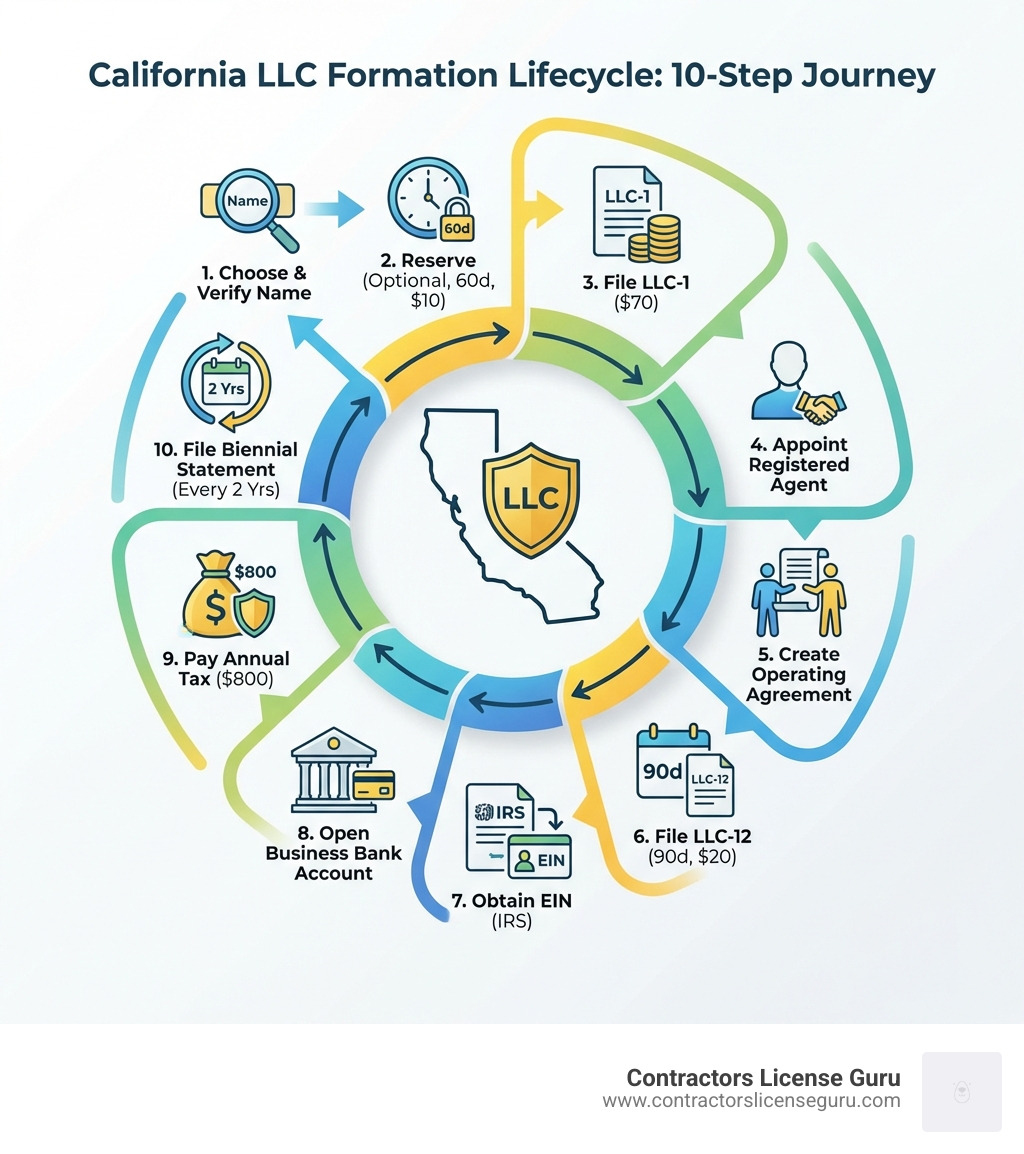
The first hurdle is your business name. California requires your LLC name to meet state naming requirements and be distinguishable from other entities on the Secretary of State’s records. We also recommend checking with the United States Patent and Trademark Office to make sure your proposed name doesn’t create a trademark issue.
You must include an LLC designator at the end of your name, such as “LLC,” “L.L.C.,” or “Limited Liability Company.” If you want to use a name different from your legal LLC name for marketing, you’ll need to look into Do I Need a DBA? and any applicable fictitious business name requirements.
Finally, you must designate an Agent for Service of Process. This is the individual or registered corporate agent designated to accept service of process and other legal documents on behalf of your LLC.
If you designate an individual, that person must reside in California and provide a physical California street address. The Secretary of State makes this information part of the public record.
Some business owners designate themselves or another qualifying individual, while others use a professional service for convenience and privacy. You can learn more in our Agent for Service of Process guide.
Before you fall in love with a name, check the California business name database.
If your chosen name is available, you can move forward with filing or choose to reserve it first.
A California LLC name can generally be reserved for 60 days. Name reservation can be helpful if you’re still getting your ducks in a row but don’t want someone else to take the name before you file your Articles of Organization.
Take your time here. Business-name problems can delay your filing and may also create issues later with your CSLB license if the business name isn’t compatible with the classification you’re seeking.
This is the “birth certificate” of your business. To officially form a California LLC, you’ll file your Articles of Organization through bizfile Online.
The Articles of Organization require information including:
The filing fee is currently $70.
If the thought of government forms gives you hives, our Document Filing Service can help with the filing process.
Once the Secretary of State accepts your formation documents, you aren’t done yet. There are several additional steps involved in properly setting up and maintaining your LLC.
One of the most important internal documents is the LLC operating agreement. While it isn’t filed with the Secretary of State, California LLC law provides for an operating agreement governing the relations among members and between the members and the LLC.
An operating agreement can address issues such as ownership, management authority, voting, distributions, and what happens when a member leaves the business.
You’ll also want to address several practical setup items:
If you’re considering different federal tax elections, our article on S Corporations and Salaries provides additional background.
This is an area where a lot of business owners receive oversimplified advice.
An LLC does not universally need its own EIN simply because it was formed.
For example, according to the IRS, a single-member LLC treated as a disregarded entity for federal income tax purposes generally does not need a separate EIN if it:
In that situation, the owner may generally use their own taxpayer identification number for federal income-tax purposes.
However, an LLC generally needs an EIN when it has employees. Multi-member LLCs also generally need an EIN, as do single-member LLCs that elect corporate or S corporation tax treatment or have certain excise-tax obligations.
Even when the IRS doesn’t require an EIN for federal tax purposes, an LLC may choose to obtain one for reasons such as opening a business bank account or meeting other business requirements.
You can apply for an EIN directly through the IRS.
An operating agreement establishes the rules governing your LLC and the relationships among its members.
Even if you are a single-member LLC, having your business arrangements clearly documented can help establish how the LLC will operate.
Your agreement can cover:
For multi-member LLCs, an operating agreement becomes especially important because it can establish each member’s rights, responsibilities, economic interests, and decision-making authority.
After forming a California LLC, you must file a Statement of Information with the Secretary of State within the required initial filing period and then file another Statement of Information every two years.
You can file through bizfile Online.
The Statement of Information keeps important information about the LLC current, including business addresses, management information, and your Agent for Service of Process.
Failing to keep required filings current can result in penalties and eventually affect the LLC’s standing with the state.
California is a beautiful place to live, but it isn’t the cheapest place to run a business. When learning how to form LLC California, you need to budget for the California tax requirements that come with the entity.
California LLCs subject to the annual tax generally pay an $800 annual tax to the Franchise Tax Board.
In addition to the $800 annual tax, LLCs with enough California-source total income may owe an additional LLC fee.
The current income-based LLC fee tiers are:
These fees are based on total California income for purposes of the LLC fee—not simply the LLC’s taxable profit.
LLCs subject to California filing requirements generally use Form 568, Limited Liability Company Return of Income, for their California LLC reporting.
Because tax treatment can vary significantly based on ownership structure and elections, talk with a qualified tax professional when deciding how your LLC should be taxed.
For some contractors, it may make sense to ask, “Should I Be an S Corporation?“
An eligible LLC can elect to be taxed as an S corporation without changing the underlying California LLC entity, but whether that makes financial sense depends on the company’s income, payroll, ownership, and other circumstances.
If you’re a contractor, forming the LLC is only part of the process. The LLC itself must satisfy applicable CSLB licensing requirements before contracting under the LLC entity.
We’ve put together A Practical Guide to LLC Contractor License Requirements to help contractors understand the additional CSLB requirements that apply to LLC licenses, including bonding and liability insurance requirements.
For other permits, the CalGold permit assistance tool is a useful resource for identifying state and local permit requirements that may apply to your business.
If you plan to hire employees, you’ll also need to address payroll registration, employment taxes, and workers’ compensation requirements.
If you already formed an LLC in another state, such as Nevada or Arizona, and want that entity to conduct business in California, you generally need to register the foreign LLC with the California Secretary of State and comply with California requirements.
Yes. California allows single-member LLCs.
A single-member LLC can provide liability separation while generally being treated as a disregarded entity for federal income-tax purposes unless another tax classification is elected.
Remember that forming a single-member LLC doesn’t automatically mean you need a separate EIN. Whether an EIN is required depends on the LLC’s federal tax classification, employees, excise-tax obligations, and other circumstances.
No.
An LLC can be a strong option for many contractors, but entity selection should be based on your particular circumstances.
Factors to consider include:
A sole proprietorship, corporation, or LLC may each make sense in different situations.
Before forming an entity solely for tax or liability reasons, consider discussing your situation with a qualified attorney or tax professional.
Yes. California restricts the use of LLCs for certain licensed professional services.
If your occupation is regulated as a professional service, check the rules for your licensing agency before choosing an entity structure.
Contracting businesses, however, can operate through an LLC when CSLB’s LLC licensing requirements are satisfied.
You cannot form a California Series LLC under California law.
California may recognize series created under another state’s laws for certain purposes, but individual series doing business in California can have their own California tax and filing obligations.
That can become expensive quickly, so get professional tax and legal advice before using a Series LLC structure for California operations.
California generally does not allow an LLC to render professional services when those services may lawfully be rendered only pursuant to a professional license, certificate, or registration, except where otherwise authorized.
If you provide regulated professional services, verify the entity rules for your specific profession before forming an LLC.
If it’s time to hang up the tool belt, formally terminate the LLC rather than simply abandoning it.
You can handle California LLC termination filings through bizfile Online.
The forms and process depend on the LLC’s specific circumstances. You’ll also need to address final California tax filings and any outstanding tax obligations with the Franchise Tax Board.
Forming an LLC in California can be a powerful way to structure and protect a construction business, but it isn’t automatically the right entity for every contractor.
Your liability exposure, tax situation, CSLB requirements, ownership structure, and long-term plans should all factor into the decision.
At Contractors License Guru, we specialize in helping Sacramento contractors and business owners across California handle everything from Secretary of State filings to CSLB compliance.
Whether you need help filing business documents, understanding your Agent for Service of Process requirements, or preparing your contractor license application, we’re here to help.
Get professional help with your California contractor license application and documents and get back to what you do best—building California.