
Last updated: August 31st, 2026
If you’re planning to work in construction in California, knowing the types of contractor licenses is the first step to operating legally and growing your business. The California Contractors State License Board (CSLB) issues licenses in four main categories:
California law generally requires a contractor license for any project valued at $1,000 or more in combined labor, materials, and other costs. The exemption for projects under $1,000 applies only when the project does not require a building permit and no employee labor is used. Without the right license, you risk fines, jail time, and losing the right to collect payment for your work. Choosing the wrong classification can also limit the types of projects you can legally bid on or complete.
The challenge many contractors face is understanding which license classification matches their business scope. A Class B contractor can perform framing or carpentry projects and qualifying multi-trade building projects, but there are specific rules governing single-trade work. A Class C specialty contractor can serve as the prime contractor within the scope of their specific trade. And the newer Class B-2 license, introduced in 2021, has its own restrictions involving residential remodeling, structural work, and the number of trades involved.
I’m Phil Cocciante, and I’ve spent over 20 years helping contractors navigate the types of contractor licenses in California as a former CSLB application technician and owner of Contractors License Guru. Since 2005, I’ve guided thousands of contractors through the application process, exam waivers, and classification decisions to help them get licensed correctly the first time.
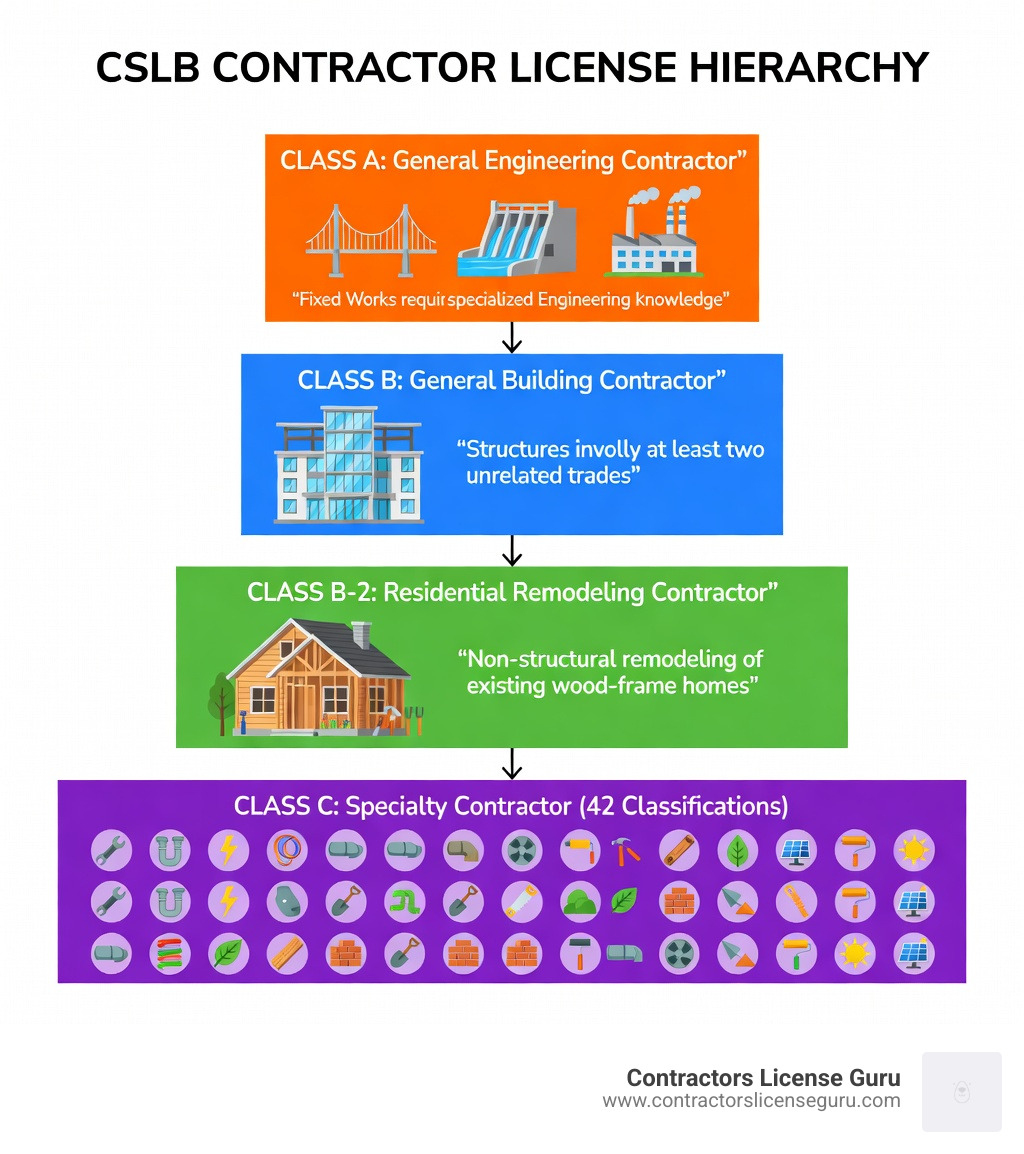
In California, the Contractors State License Board (CSLB) is the sheriff in town. According to Section 7055 of the Business and Professions Code, the contracting business is divided into three main branches, which the CSLB has further expanded into four distinct license categories.
Understanding these types of contractor licenses in California is essential because each one carries a specific “scope of work.” If you step outside that scope, you’re technically working without a license for that specific task—which is a quick way to get “nailed” by state investigators.
Whether you are looking to build skyscrapers or just remodel a kitchen, you need to find the right fit. For a deep dive into the legal definitions, check out A Complete Guide to California’s CSLB License Classifications.
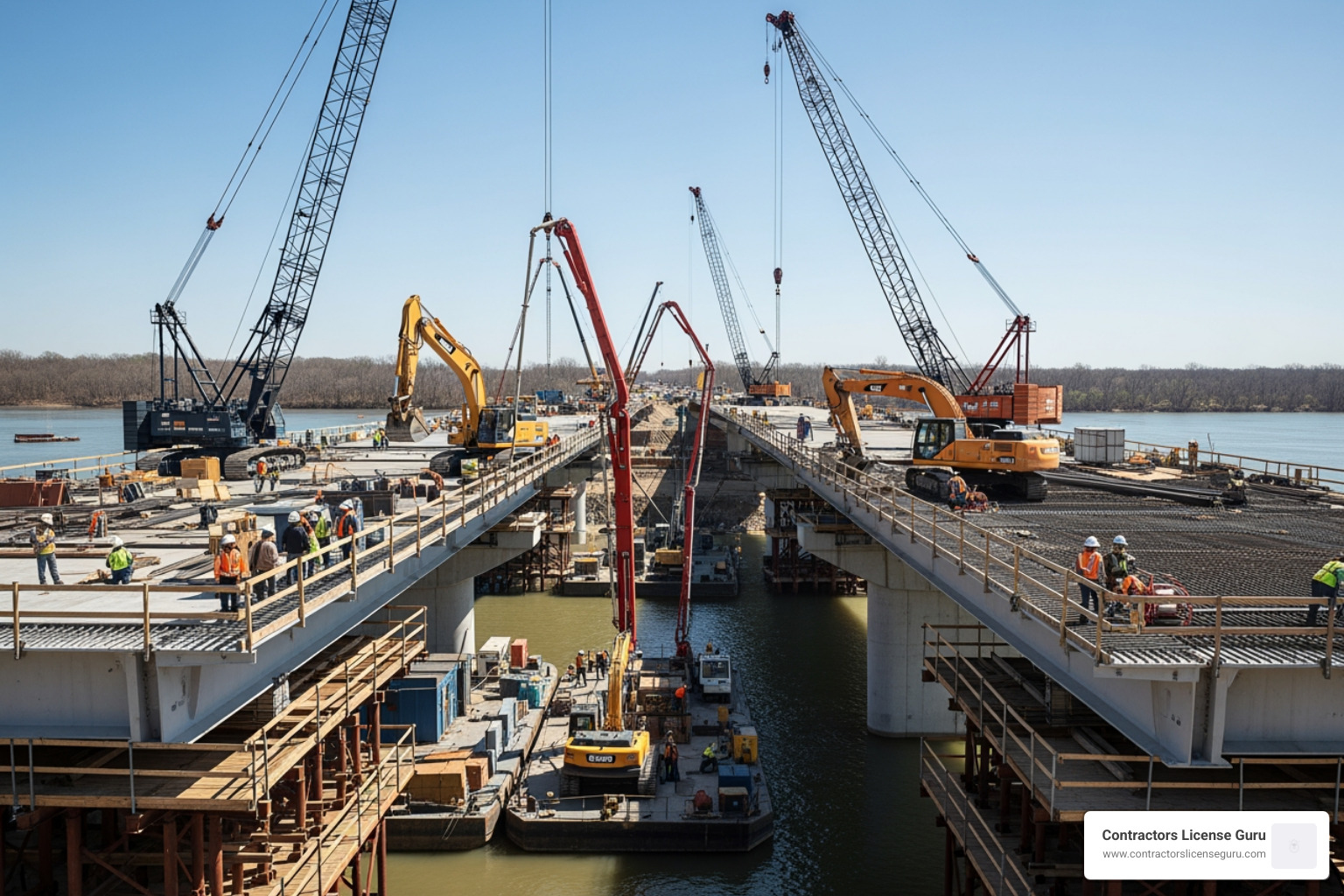
The Class A license is the “heavy lifter” of the bunch. This classification is for contractors whose principal business involves fixed works requiring specialized engineering knowledge and skill. We aren’t talking about building houses here; we’re talking about the infrastructure that keeps California running.
The scope of work for a Class A contractor includes:
If the project involves moving massive amounts of earth or building something requiring specialized engineering knowledge, it’s likely a Class A job.
The Class B license is perhaps the most common of the types of contractor licenses in California. This license is for contractors whose principal business is in connection with any structure built, being built, or to be built for the support, shelter, and enclosure of persons, animals, chattels, or movable property of any kind.
However, there is an important rule that trips up many new contractors.
A Class B General Building contractor may take a prime contract or subcontract for a framing or carpentry project without needing a second trade.
For projects involving trades other than framing or carpentry, a Class B contractor generally must have at least two unrelated building trades or crafts other than framing or carpentry. Framing and carpentry cannot be counted toward those two unrelated trades.
There are also important differences between prime contracts and subcontracts.
For a prime contract involving a single specialty trade, a Class B contractor may take the project if the contractor holds the appropriate specialty classification or subcontracts the specialty work to an appropriately licensed specialty contractor.
For a subcontract involving a single specialty trade other than framing or carpentry, the Class B contractor generally must hold the appropriate specialty classification.
For example, if you are doing a kitchen remodel that requires plumbing, electrical, and cabinetry, a Class B license may be appropriate. But if you are taking a subcontract only to perform roofing, you generally need the C-39 Roofing specialty classification.
You can learn more about these nuances in our guide on Licensing Options in California: General vs. Specialty Contractor Licenses.
If you’re preparing for this classification specifically, see our guide to the California B General Building Contractor Exam.
Introduced in 2021, the Class B-2 Residential Remodeling Contractor classification is specifically designed for qualifying remodeling projects involving existing residential wood-frame structures.
Unlike the Class B General Building license, a B-2 contractor must have a single contract that includes at least three unrelated building trades or crafts.
Work that may fall within a qualifying B-2 project includes:
The B-2 classification also has important limitations:
This makes B-2 a distinctly different classification from the broader B-General license. Contractors who specialize in multi-trade residential remodeling need to understand these limitations before determining which classification fits their experience and the type of projects they plan to perform.
For a full breakdown of the available classifications, see our California Contractors License Classifications page.
When we talk about the types of contractor licenses in California, the Specialty (Class C) category is where the list gets long. There are currently 42 separate C-license classifications issued by the CSLB.
Specialty contractors are those who perform a specific trade, like electrical work, plumbing, or landscaping. These contractors can take prime contracts working directly for the owner if the job is within the scope of their specific trade. They also frequently work as subcontractors for Class A or Class B contractors.
While there are dozens of specialties, a few stand out as the most popular:
If you don’t fit into a standard box, the CSLB also offers the D-64 Non-Specialized Contractor classification for very specific niche work. You can review the specialty classifications on our California Contractors License Classifications page.
The C-61 Limited Specialty classification covers specialized scopes of work that do not fall within one of the standard specialty classifications.
Some examples include:
Unlike other Class C licenses, the C-61 does not require a trade-specific exam; applicants are generally required to pass the Law and Business exam.
Beyond the standard types of contractor licenses in California, there are specialized certifications for dangerous work.
Getting your license isn’t just about picking a category; you have to prove you know your stuff. The CSLB has strict requirements to ensure that qualified individuals are out there building California.
| Requirement | Class A | Class B / B-2 | Class C |
|---|---|---|---|
| Min. Age | 18 Years | 18 Years | 18 Years |
| Experience | 4 Yrs Journey-Level | 4 Yrs Journey-Level | 4 Yrs Journey-Level |
| Exams | Law & Trade | Law & Trade | Law & Trade* |
| Bond | $25,000 | $25,000 | $25,000 |
*Note: C-61 Limited Specialty does not require a trade exam.
To qualify for these types of contractor licenses in California, applicants generally must have at least four years of qualifying journey-level experience within the applicable 10-year period. Qualifying experience may include work performed as a journeyman, foreman, supervising employee, contractor, or owner-builder, depending on the circumstances and classification being requested.
For a broader look at the licensing process and requirements, see our California Contractor License 101 guide.
Choosing your classification should be based on your “primary business.” If you are a plumber by trade, get a C-36. If you want to build or remodel structures and manage qualifying multi-trade projects, the Class B may be the better fit.
If you deal with very specific items, like pre-built structures, you might look into the D-34 Prefabricated Equipment Contractor classification.
Ask yourself:
If you’re still deciding between classifications, our General vs. Specialty Contractor License guide can help explain the differences.
Running a legal construction business in California isn’t free. Here is a breakdown of the costs:
While your CSLB license is valid statewide, many cities have their own hoops you need to jump through. We always remind our clients that a state license is just the beginning.
In major cities like Los Angeles, San Diego, and San Francisco, contractors may also need to obtain local business licenses, registrations, or tax certificates.
Always check the requirements for the city or county where you plan to operate.
Insurance is your safety net. Depending on the project, location, classification, and business structure, additional insurance requirements may apply.
One of the biggest changes in the industry involves workers’ compensation. Certain classifications are already required to maintain workers’ compensation insurance even if they have no employees. Under current law, by January 1, 2028, all active California contractor license holders will be required to carry workers’ compensation insurance, regardless of whether they have employees.
If you are coming from out of state, California has limited reciprocity agreements with Arizona, Nevada, and Louisiana. Depending on the classification and your licensing history, you may qualify for a waiver of the trade examination. You will still need to satisfy California’s other licensing requirements.
In California, a contractor generally needs a license if the total price of a project is $1,000 or more, including labor, materials, and all other costs.
A license is also required for work under $1,000 when the project requires a building permit or employee labor is used.
There are several exemptions, but they have specific limitations:
Working without a license is a misdemeanor in California. Violations can result in fines, possible jail time, and additional penalties for repeat offenses.
Perhaps worse for your wallet is California’s “disgorgement” rule. An unlicensed contractor may be required to return compensation received for work that required a contractor license. Unlicensed contractors can also lose important legal remedies for collecting unpaid compensation.
The licensing timeline can vary depending on application volume, the classification requested, examination requirements, background checks, and whether CSLB needs additional information.
Once your application is accepted, CSLB provides instructions regarding examinations and any remaining requirements before the license can be issued.
For a deeper explanation of the agency and licensing process, read Contractors State License Board California: A Complete Guide.
Navigating the various types of contractor licenses in California can feel like trying to read a blueprint in the dark. But getting it right is the difference between a thriving business and a legal nightmare. From the heavy engineering of Class A to the specialized trades of Class C, each license serves a vital role in California’s economy.
At Contractors License Guru, we make the process simple. Whether you need application assistance, study guides, or expert advice on which classification fits your experience, we are here to help. We’ve spent years mastering the CSLB’s requirements so you don’t have to.
If you need help preparing your application or determining which classification fits your experience, learn more about the services offered by Contractors License Guru.
Ready to build your future? Check out A Complete Guide to the California Contractors State License Board and let’s get your application started today!